12 Best Bench Vises of 2026: Durable Ductile Iron Models for Serious Work

The best bench vises of 2026 that clamp securely without breaking — from heavy-duty ductile iron workhorses to compact hobby models.

A bench vise is supposed to be the anchor of your workbench — the one tool you trust not to fail when you're reefing on a stuck bolt or planing a long board. But scroll through the reviews of even top-selling vises, and you'll find stories of front jaws shattering, swivel bases slipping, and handles bending under normal use. The difference between a vise that lasts a decade and one that cracks in two months often comes down to something invisible: the iron it's cast from, not just the jaw width.

This guide cuts through the spec-sheet hype to focus on the materials, clamping consistency, and design features that separate real workhorses from disposable tools. Whether you're a weekend woodworker, a car tinkerer, or building your first shop, you'll find a vise matched to your work — without the gamble.

1

Best Overall Bench Vise

VEVOR 6" Bench Vise

94 /100
Craft Score Outstanding

Key details

Swivel Range
360° swivel base
Material & PSI
60,000 PSI ductile iron
Included Features
Pipe jaws, anvil, soft pads, hardware
Jaw Width & Opening
6" / 5.9"
View on Amazon

The VEVOR’s 60,000 PSI ductile iron body is the line between a vise that bends and one that shatters. That material choice — rare at this price — pairs with an Acme-threaded main screw and twin guide rods to produce a jaw glide that stays parallel even under a full 20 kN squeeze. The smooth enameled finish resists rust and shrugs off cutting oil, while the integrated 2.9-inch by 3-inch anvil takes light hammering without denting.

When you lock down the 6-inch jaws, the grip holds steady through hand-saw strokes and drill-press pecking. Under sustained lateral vibration from a bench grinder, the swivel base can drift a degree or two over minutes — a quick hand-tighten on the lock handle stops it. Included mounting bolts and magnetic soft jaw pads eliminate an extra trip to the hardware store, a practical touch often omitted on higher-priced competitors.

The VEVOR 6-inch vise locks in as the centerpiece of a home mechanic’s bench, a metalworking station, or a weekend woodworking setup. The 5.9-inch jaw opening swallows brake rotors, tubing, and 2×6 stock without complaint, and the 360-degree swivel positions awkward angles without unbolting the vise. It is not the right call for cramped worktops where every inch of space is spoken for, or for a production shop that cycles through dozens of unpredictable shock loads daily. A quick visual check of the casting upon arrival weeds out the rare unit with a flaw; a sound casting stands ready for years of heavy use.

💡 Swivel lock can gradually loosen under vibration; a dab of removable thread-locking compound on the bolt threads subdues it for good.

Pros

  • 60,000 PSI ductile iron construction at a mid-range price that blows past typical cast-iron alternatives.
  • Jaws close with dead-straight alignment and hold workpieces tight without slipping, even under heavy torque.
  • Thick iron anvil and robust mounting ears let you hammer and pry without the vise protesting.
  • Four hex-head bolts and two magnetic soft jaw pads are included, so you can mount it the moment you open the box.

Cons

  • Swivel base lock may creep when subjected to continuous lateral vibration from a bench grinder or heavy filing.
  • A hairline casting flaw can appear on a small number of units, causing a jaw to fracture under shock loads
Our verdict

Give the casting a quick once-over when it lands. A sound VEVOR 6-inch delivers clamping authority and iron toughness that hang with bench vises costing twice as much — and takes up exactly the right amount of bench.

Check Latest Price
2

Best Heavy-Duty & Large Capacity

Forward CR80A 8" HD

95 /100
Craft Score Outstanding

Key details

Swivel Range
190° swivel base
Material & PSI
60,000 PSI ductile iron
Included Features
Pipe jaws, anvil
Jaw Width & Opening
8" / 9"
View on Amazon

The 9-inch jaw opening — nearly 50% wider than most workshop vises — accommodates a full brake rotor, wide tube stock, or a small engine block without repositioning. The 60,000 PSI ductile iron body and 12,000-lb clamping force let you apply serious torque without cracking. Built-in pipe jaws handle stock from 1/2 to 3-1/2 inches, and the integrated anvil gives a flat striking surface for light shaping. Unlike the top pick's 360° swivel and lower price, this vise trades rotational flexibility for raw gripping span.

Fabrication shops and automotive DIYers tackling large assemblies will appreciate the sheer capacity, but the 42-lb weight and 8-inch jaw require a sturdy, spacious bench. Budget-minded buyers will find the premium price a steep entry. Expect to tighten the swivel base lock periodically during high-vibration work like grinding or hammering.

Pros

  • 60,000 PSI ductile iron casting holds up to heavy hammering without cracking.
  • Smooth-operating lead screw applies steady, strong grip across the full 9-inch range.
  • Pipe jaws from 1/2 to 3-1/2 inches and massive capacity accommodate oversized assemblies.

Cons

  • Clamping force may slip under extreme lateral pressure; heavy pushes may need supplementary bracing.
Our verdict

For anyone routinely gripping large stock that overpowers standard 6-inch vises, the Forward CR80A delivers unmatched jaw capacity and brute strength, as long as the occasional swivel lock tightening fits the workflow.

Check Latest Price
3

Best Premium Lifetime Investment

Wilton WS6 6" Shop

92 /100
Craft Score Outstanding

Key details

Swivel Range
360° with double lockdowns
Material & PSI
60,000 PSI ductile iron
Included Features
Jaw Width & Opening
6" / 6"
View on Amazon

Where the top pick combines versatility and affordability, this Wilton delivers a vise meant to outlast its owner. The fixed 6-inch jaw and double-lockdown 360° swivel base channel 60,000 PSI ductile iron into a single, unbreakable anchor. Unlike multi-purpose rotating-head vises that sacrifice rigidity for articulation, the WS6 prioritizes raw clamping power and durability, backed by a lifetime warranty.

Professional woodworkers, metalworkers, and serious DIYers who want a once-in-a-lifetime vise will find their permanent workshop companion here. The 42-pound vise demands a rigid bench; mounting hardware is not included, so you will source your own bolts. Swivel alignment may need fine-tuning out of the box, but once adjusted, the double lockdowns hold position under heavy torque. Its heft also dampens vibration during aggressive filing and grinding.

Pros

  • 60,000 PSI ductile iron construction withstands heavy hammering without cracking.
  • Lifetime warranty backs the vise for the long haul
  • Premium price reflects heirloom-quality materials, not a disposable tool.

Cons

No notable drawbacks to flag.

Our verdict

Bolt it down, dial it in, and it becomes the permanent anchor of your bench — a tool destined for hand-me-down status.

Check Latest Price
4

Best for Versatile Angled Clamping

Forward DT150B 6" Rotating

93 /100
Craft Score Outstanding

Key details

Swivel Range
360° rotating head & base
Material & PSI
60,000 PSI ductile iron
Included Features
Jaw Width & Opening
6" / 5"
View on Amazon

The DT150B’s dual-axis rotation — a solid 360° swivel head atop a 360° swivel base — turns complex clamping angles into routine setup. Where large-opening vises prioritize swallowing long stock, this design excels at angular precision. Gunsmiths, fabricators, and metalworkers can clamp parts at odd orientations without stacking wood blocks or repositioning. The 6,500 lbs clamping force from the ductile iron jaws backs up the agility with serious holding power.

This vise fits anyone regularly holding irregular or angled workpieces—from sight mounting to pipe welding. It’s overkill for simple straight-line clamping, where a fixed-jaw vise is quicker. The rotating head earns its keep on jobs that demand compound angles, but the out-of-box swivel can be stiff; a few minutes with grease and a break-in period gets it gliding smoothly.

💡 Before side-loading, cinch the swivel locks extra tight; the jaws hold alignment once the locks are fully seated.

Pros

  • The high-strength cast iron and 60,000 PSI ductile iron construction give a heavy, vibration-dampening feel under the hammer
  • Dual swivel lets you angle parts in multiple planes simultaneously, eliminating awkward clamping workarounds on irregular pieces.
  • At its premium price, the clamping force, ductile iron toughness, and dual-axis rotation undercut fixed-head vises in the same tier, making it a strong feature-per-dollar pick.

Cons

No notable drawbacks to flag.

Our verdict

If your projects demand holding angled, irregular parts without constant repositioning, the Forward DT150B justifies its price with a rotating head design that turns complicated setups into simple clamp-and-go operations.

Check Latest Price
5

Best Woodworking Vise with Quick-Release

Yost M9WW 9" Rapid Action

92 /100
Craft Score Outstanding

Key details

Swivel Range
Material & PSI
30,000 PSI cast iron, steel guides
Included Features
Quick-release lever
Jaw Width & Opening
9" / 10.25"
View on Amazon

The Yost M9WW’s 9-inch jaw, 10.25-inch opening, and quick-release lever reshape workflow for furniture and cabinet builders who constantly reposition long panels. Where general-purpose vises split their attention between pipe jaws and swivel bases, this tool channels its mass into holding wide boards without compromise. The lever slides the jaw freely, then locks with a partial turn, eliminating the endless cranking that slows down deep-stock work.

This vise targets dedicated woodworking shops where the time saved on each panel repositioning matters. The 30,000 PSI castings and alloy steel guide rails resist flex under heavy planing, but jaw parallelism can need shimming or adjustment straight out of the box. That makes it a poor fit for the ‘mount and forget’ crowd, but a reasonable tradeoff for the capacity gained. Expect to have a helper or a temporary prop on hand—at 32 pounds, solo installation is awkward.

💡 Jaw parallelism can be corrected by loosening the mounting bolts slightly and inserting brass shims between the jaw and casting before retightening.

Pros

  • Beefy 30,000 PSI cast iron and alloy steel guide rails resist flex under heavy planing loads
  • Quick-release lever frees the jaw for sliding, then locks with a partial turn—no tedious cranking on deep stock
  • 9-inch jaw and 10.25-inch throat accept wide cabinet panels and large glue-ups without outgrowing the vise

Cons

  • At 32 lbs, mounting solo demands a helper or temporary support—install once, then reap the stability
  • Jaw parallelism may need shimming out of the box; not a drop-on-and-go solution for all benches
Our verdict

For a cabinet shop that repositions panels dozens of times a day, the rapid action and wide capacity offset the one-time alignment tweaks. Bring a helper for mounting and keep shim stock nearby, and this 9-inch vise outpaces smaller woodworking vises on every long-board job.

Check Latest Price
6

Best Multi-Angle Hobby Vise

Stanley MaxSteel Hobby Vise

93 /100
Craft Score Outstanding

Key details

Swivel Range
360° ball joint
Material & PSI
Included Features
Clamp-on, rubber jaws
Jaw Width & Opening
View on Amazon

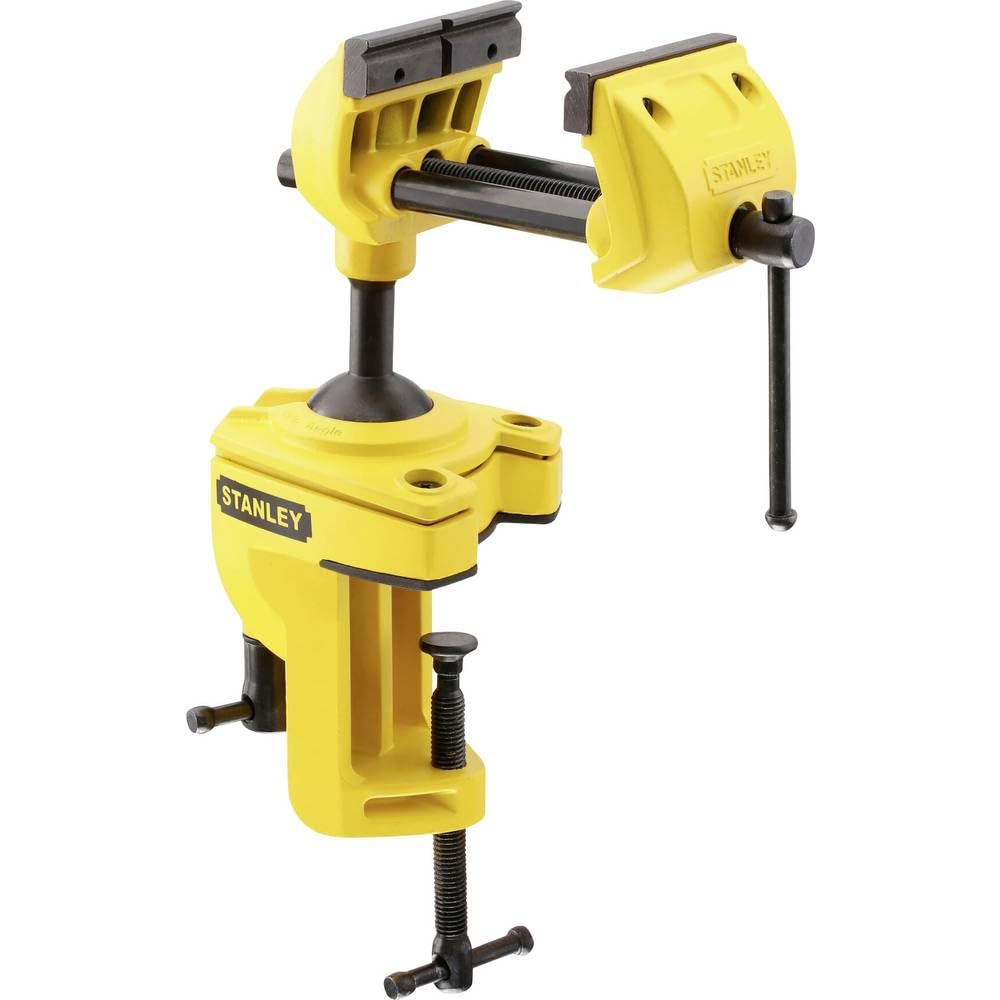
The Stanley MaxSteel Hobby Vise stands apart from traditional bench vises with a ball joint that rotates 360 degrees and locks at any angle, giving hobbyists complete control over workpiece orientation. The removable rubber jaws and clamp-on mount make it easy to reposition across different work surfaces, and the steel build withstands daily use without slipping or loosening. For tasks like soldering, scope mounting, or fine sanding, the ability to tilt and spin the piece eliminates the awkward postures often forced by fixed-jaw vises.

Model builders, electronics hobbyists, and crafters will find the articulation and lightweight design ideally suited for small, precise projects. The vise clamps securely to tables up to about 2 inches thick, and its 3.3-pound weight allows quick stowing when not in use. The jaw capacity, however, is deliberately compact — it will not accept workpieces larger than a few inches, nor can it handle heavy hammering or bending. This is a precision positioning tool, not a heavy-duty bench vise. Buyers who need to secure large stock or apply substantial force should choose a full-size fixed vise instead.

Pros

  • Durable steel construction holds up to years of daily hobby use without loosening or stripping.
  • Ball joint locks securely in any position, letting you rotate work without repositioning the vise.
  • Suited for whipmaking, model building, and electronics assembly

Cons

  • Jaw opening is narrow, limiting the vise to small parts and light-duty work; cannot secure larger stock.
Our verdict

If your workbench calls for fine control at any angle on small components, the Stanley MaxSteel provides it with proven durability. For clamping 2x4s or hammering out dents, a full-size bench vise remains the right tool.

Check Latest Price
7

Light Home Repairs

WORKPRO 4.5" Bench Vise

89 /100
Craft Score Excellent

Key details

Swivel Range
240° swivel base
Material & PSI
Gray iron
Included Features
Jaw Width & Opening
4.5" / 3.75"
View on Amazon

This gray iron vise holds small workpieces securely for gluing, soldering, and light plumbing. The 240° swivel base allows flexible positioning, though the lock may slip under heavy side-load torque — a reminder that this isn't a vise for automotive or metal fabrication work. At a budget-friendly price, it's a sensible choice for apartment workbenches and hobby stations where space and strength demands are modest.

Pros

  • Holds small workpieces securely for gluing, soldering, and light assembly tasks.
  • Provides good value for occasional hobby and household use at a budget-friendly price.

Cons

  • Under heavy side load, the swivel base lock may loosen, so it's not suited for automotive or high-torque work.
Our verdict

For a small-space bench that handles light crafts, plumbing repairs, or hobby assembly, this compact vise delivers adequate clamping without the bulk or cost of larger models.

Check Latest Price
8

Starter Wood Bench

IRWIN 6.5" Woodworker

93 /100
Craft Score Outstanding

Key details

Swivel Range
Material & PSI
Cast iron
Included Features
Toe-in jaws, wood cheeks
Jaw Width & Opening
6.5" / 4.5"
View on Amazon

Cast iron construction and toe-in jaws make this a straightforward face vise for light woodworking. It bolts on easily, accepts wooden cheek plates, and handles glue-ups, chiseling, and sanding on small stock. However, the jaw opening is limited to 4.5 inches and clamping force falls below what's needed for heavy planing or metalworking. Over time, the screw may lose some bite. This suits a secondary vise or a first bench for joinery practice, not production work.

Pros

  • Delivers acceptable clamping for light woodworking tasks like chiseling and sanding.
  • Easy to mount and includes toe-in jaws ready for wooden cheek plates.

Cons

  • Clamping pressure can loosen with repeated use
Our verdict

A perfectly serviceable first face vise for a hobby bench, provided you limit work to joinery and small parts rather than heavy stock removal.

Check Latest Price
9

Long Stock Clamping

Pony Jorgensen 7" Wood Vise

90 /100
Craft Score Outstanding

Key details

Swivel Range
Material & PSI
Cast iron, steel guides
Included Features
Face mount
Jaw Width & Opening
7" / 9"
View on Amazon

The Pony Jorgensen's generous 9-inch opening and steel guide bars deliver stable holding for long stock during glue-ups or light furniture assembly. Its price puts it among the most affordable wide-opening face vises available. The lead screw, however, is not built for sustained heavy clamping; repeated max-force tightening can strip the threads over time. That limits it to occasional woodworking, not daily production. If your shop handles a few furniture projects a year, the capacity-to-cost ratio is hard to beat.

💡 Shim the rear jaw to correct any face alignment variance — a quick fix that lets you dial in square clamping.

Pros

  • Wide 9-inch opening accommodates long boards and panels during assembly
  • Budget-friendly price makes wide-capacity clamping accessible to beginners

Cons

  • Lead screw threads can strip under repetitive high-clamp force
Our verdict

This vise suits hobbyists clamping long stock, as long as they respect its medium-duty screws and are willing to shim alignment if needed.

Check Latest Price
10

Multi-Angle Utility

Wilton 550P 5.5" Multi

90 /100
Craft Score Outstanding

Key details

Swivel Range
360° indexed rotating head
Material & PSI
30,000 PSI cast & ductile iron
Included Features
Pipe jaws, 30° index
Jaw Width & Opening
5.5" / 5"
View on Amazon

The Wilton 550P combines a 360° indexed rotating head with built-in pipe jaws, delivering flexible workholding for angled drilling, gunsmithing, and hobbyist projects not demanding brute force. The 5.5-inch ductile and cast iron construction stands up to daily shop use, and Wilton’s lifetime warranty backs the build. The rotating head lock can slip under heavy lateral pounding, and the handle can arrive bent or deform under high clamping torque — boundaries that make this vise better suited to moderate-duty tasks than to full-on sledgehammer work.

Pros

  • Well-engineered Wilton construction stands up to daily moderate-duty use.
  • 360° indexed rotating head and pipe jaws handle irregular workpieces and round stock with ease.

Cons

  • Handle can arrive bent or may bend under high clamping force.
  • Rotating head lock may slip under heavy lateral pounding, causing workpiece movement.
Our verdict

If angled workholding and pipe clamping matter more than brute impact resistance, the Wilton 550P delivers. Keep the sledgehammer away, and it handles most hobbyist and gunsmithing tasks with ease.

Check Latest Price
11

Gunsmithing Precision

Real Avid Master Gun Vise

93 /100
Craft Score Outstanding

Key details

Swivel Range
360° ball & socket with leveling
Material & PSI
Included Features
Gun-fit sleeves, leveling
Jaw Width & Opening
5" / —
View on Amazon

The ball-and-socket joint with a dedicated leveling knob lets you micro-adjust workpiece angles for scope mounting or bow tuning without loosening the main clamp. Reversible jaw sleeves protect firearm finishes and fit odd shapes. For general-purpose workshop clamping — especially tasks that involve hammering or prying — the 5-inch jaw width and mid-range price tag put it at a disadvantage next to ductile-iron vises with larger capacities. Gun owners who also need routine cleaning and sight work will find its precision unmatched, but buyers seeking a rugged all-purpose vise should look elsewhere.

Pros

  • Micro-adjustable ball joint allows precise leveling and full articulation for scope mounting and cleaning.
  • Reversible gun-fit jaw sleeves protect firearm finishes and securely hold irregular shapes such as compound bows.

Cons

  • Price feels steep if you only need basic clamping
Our verdict

For gunsmiths, firearm enthusiasts, and bow tuners who need micro-adjustable clamping, this vise delivers precision that general-purpose vises can't match. Workshop users who rarely mount scopes or clean long guns will be better served by a traditional ductile-iron bench vise.

Check Latest Price
12

Heavy Pipe & Bench

Yost 480 8" Combo

93 /100
Craft Score Outstanding

Key details

Swivel Range
360° geared base
Material & PSI
30,000 PSI cast iron, steel U-channel
Included Features
Pipe jaws, steel channel
Jaw Width & Opening
8" / 7.5"
View on Amazon

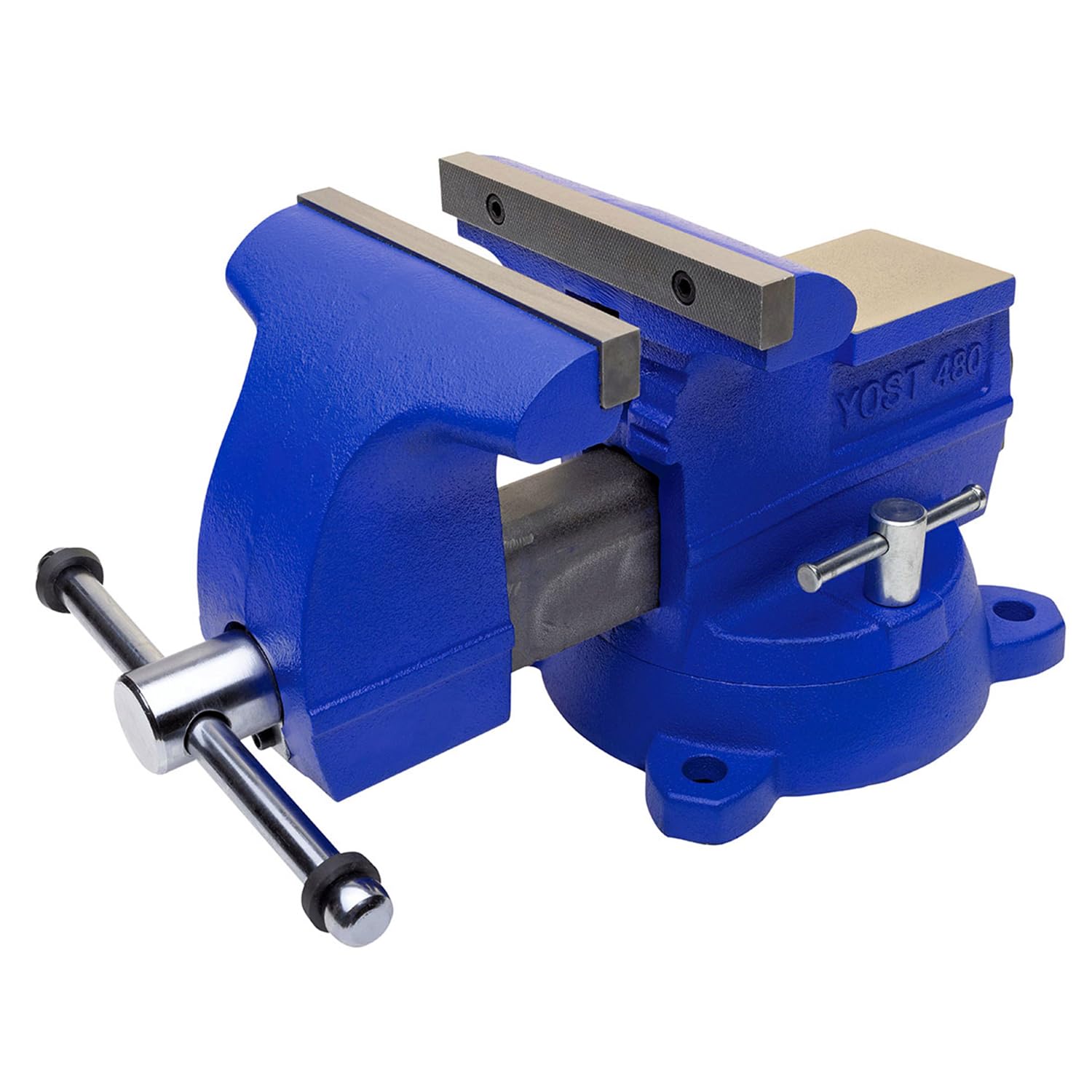
The Yost 480 combines an 8-inch jaw, 7.5-inch opening, and 360° geared swivel with pipe capacity up to 3 inches—a massive vise built for heavy automotive repairs and pipe fitting. The cast-iron body with steel U-channel provides solid durability for the price. However, the swivel base may not hold dead-still under heavy off-center clamping, and the handle can bend under extreme torque. For a shop that prioritizes opening capacity over lock-down precision, this 80-lb vise delivers strong value, though a more refined 8-inch option like the Forward CR80A offers a tighter swivel lock.

💡 Tighten the swivel lock with a quick tap from a mallet before off-center clamping—this can help the base hold position.

Pros

  • Cast-iron body with steel U-channel offers solid mid-range durability.
  • Massive 8-inch jaw with 7.5-inch opening and 3-inch pipe capacity at a value price.

Cons

  • Handle can bend under extreme torque.
  • Swivel lock may slip under heavy side load, limiting precision angle work.
Our verdict

For a large workshop that needs a heavy-duty combination vise with generous pipe capacity, the Yost 480 is a strong pick, provided you can tolerate occasional swivel lock movement.

Check Latest Price

How to Choose

Jaw Width and Opening

Jaw width dictates the maximum workpiece width you can grip flat; opening determines how far the jaws separate. A 6-inch vise with a 6-inch opening handles most home shop tasks, from furniture assembly to brake jobs. But dedicated woodworkers often need 9 inches or more to hold panels vertically for dovetailing or edge planing.

A vise that opens very wide may sacrifice clamping force at full extension — the lead screw has less thread engagement, reducing mechanical advantage. If you frequently work with long boards or large-diameter pipe, prioritize opening over jaw width, but understand that the hold may be slightly less rigid at the extreme.

Material Strength (PSI)

Cast iron rated at 30,000 PSI is common in budget vises and fine for light clamping, but it is brittle — it snaps rather than bends. Under heavy torque, hammering on the anvil, or a lateral blow, a cast iron jaw or body can shatter without warning. Ductile iron at 60,000 PSI behaves more like mild steel, deforming slightly before failure, which provides a critical safety window.

Manufacturers often hide the material grade behind paint. Look for clear 'ductile iron' or '60,000 PSI' labeling. If you ever plan to use a cheater bar on the handle or strike a workpiece with a hammer while in the jaws, ductile iron is the non-negotiable upgrade that turns a potential danger into a controlled job.

Swivel Range and Lock Security

A swivel base lets you rotate the vise to work from different sides without repositioning the workpiece, saving time on complex jobs. The lock, however, must resist twisting forces. Many budget vises use a single friction bolt that loosens under vibration or side load, causing the vise to spin unexpectedly.

Double-lock systems or geared swivel bases (like those on some premium models) provide a positive mechanical lock that won't creep. If you regularly apply off-axis force — such as bending metal or using the vise as a press — a simpler fixed-base design or a well-engineered lock is safer than a wide swivel that can't hold.

Clamping Force

Advertised clamping force numbers are calculated, not measured, and rarely reflect real-world results. A vise's actual grip depends on lead screw design, lubrication, and jaw alignment — rough threads and sloppy fits rob force. For most home tasks, 3,000 to 5,000 lbs is more than adequate; only heavy automotive pressing or large pipe work warrants 10,000+ lb ratings.

Don't be seduced by extreme numbers on a budget vise. High clamping force in a weak casting simply means the vise will fail at a higher load. Focus on the material and build quality first, then use clamping force as a secondary differentiator among well-built models.

Included Features and Accessories

Built-in pipe jaws are convenient for round stock but can reduce the flat jaw area and sometimes become a stress riser if poorly cast. An anvil surface is handy for light tapping but is not a substitute for a dedicated anvil — heavy hammering can crack the vise body. Replaceable jaw faces protect both the workpiece and the vise itself, extending service life.

The core of a vise's value is its clamping integrity. A vise with superb jaw alignment, smooth screw action, and stout materials will outperform a feature-laden model with slop every time. Prioritize fundamentals; accessories are a bonus, not the main event.

Frequently Asked Questions