11 Best Circular Saw of 2026: Match Blade Size and Power to Your Tasks

Which circular saw handles your cuts without breaking the bank or wearing you out? This guide matches blade size, power source, and features to DIY projects and professional work.

Choosing a circular saw often comes down to trade-offs between power, portability, and price. A budget corded model may offer great value but skip safety features like a blade brake, while a compact cordless saw trades cut depth for easy handling. Understanding these limits upfront saves frustration.

This guide matches saws to specific tasks - from ripping plywood with a lightweight sidewinder to framing with a worm drive. We focus on the specs that actually matter: blade size, motor speed, weight, and whether a brake is included. The right saw makes the cut effortless.

1

Best Overall

DEWALT DWE575SB

96 /100
Craft Score Outstanding

Key details

Bevel
57°
Brake
Yes
Weight
8.8 lbs
Blade Size
7-1/4 in.
View on Amazon

At 8.8 lbs, the DWE575SB undercuts every other 7-1/4-inch corded sidewinder in its class. The 15-amp motor spins at 5200 RPM, delivering smooth cuts through dimensional lumber and plywood without bogging down. The aluminum base stays flat and the 57-degree bevel capacity covers trim work and compound angles that most saws cap at 50 degrees.

This saw suits carpenters and serious DIYers who want a lightweight daily driver with pro features like an electric brake and depth-stop. The brake may occasionally pause before stopping — a known quirk that doesn't affect cutting performance. Those who prefer worm-drive torque for heavy framing should look elsewhere, and budget-focused buyers will find cheaper alternatives without a brake or 57-degree bevel.

💡 If the brake seems slow, a quick off-on trigger cycle may reset the electronics — a minor quirk that rarely affects workflow.

Pros

  • Lightest 7-1/4-inch corded saw at 8.8 lbs for less fatigue on long cuts
  • 15-amp motor with 5200 RPM enough for pressure-treated lumber and hardwoods
  • Durable aluminum base and smooth blade path for clean, accurate cuts

Cons

  • Electric blade brake may occasionally delay engagement
  • No laser guide
Our verdict

For anyone who wants a lightweight corded saw that doesn't compromise on power or bevel range, the DWE575SB is a straightforward pick — just understand the brake isn't instant every time.

Check Latest Price
2

Best Value Corded Saw

SKIL 5280-01

95 /100
Craft Score Outstanding

Key details

Bevel
51°
Brake
No
Weight
8.7 lbs
Blade Size
7-1/4 in.
View on Amazon

The SKIL 5280-01 packs 15 amps and a laser guide into a lightweight 8.7-lb body at a budget-friendly price point, making it a strong option for DIYers who need occasional cuts and want guidance on the cut line. It lacks the electric brake found on the top pick, but the laser helps keep cuts on track. The depth adjustment lever can break with repeated adjustments, so it is best handled carefully and suited for intermittent use.

💡 To extend the lever's life, avoid overtightening and adjust depth with a gentle hand.

Pros

  • Exceptional value for budget-conscious buyers
  • 15-amp motor cuts through dimensional lumber quickly
  • Laser guide improves cut accuracy on long rips

Cons

  • Depth adjustment lever may break after repeated use
Our verdict

For DIYers who want a capable corded saw without the premium price, the SKIL 5280-01 offers consistent cuts - just be mindful of the depth lever.

Check Latest Price
3

Best Cordless Full-Size Saw

DEWALT DCS570B

95 /100
Craft Score Outstanding

Key details

Bevel
57°
Brake
Yes
Weight
7.5 lbs
Blade Size
7-1/4 in.
View on Amazon

Delivers full 7-1/4-inch cut depth in a cordless package, with a brushless motor and 57° bevel range. For users with existing DEWALT 20V batteries, this saw offers cordless convenience without sacrificing cut capacity. The electric brake and LED light aid precision and safety. Best suited for serious DIYers and prosumers who value mobility and already have batteries. The high price without battery is a barrier for newcomers, and occasional motor stoppages have been reported, so a backup saw may be prudent for heavy use.

Pros

  • Brushless motor delivers high RPM for smooth cuts in dimensional lumber and plywood.
  • Full 7-1/4-inch blade provides maximum cut depth for standard framing timber.
  • Good battery life when paired with 5Ah packs for longer cutting sessions.

Cons

  • High initial cost as tool-only requires separate battery purchase.
  • Occasional motor cutout during use may interrupt workflow.
Our verdict

For DEWALT 20V MAX owners needing full-size cordless capability, this saw is a capable choice despite the bare-tool pricing and occasional motor quirks.

Check Latest Price
4

Best Compact Cordless Saw

DEWALT DCS571B

95 /100
Craft Score Outstanding

Key details

Bevel
45°
Brake
Yes
Weight
6.5 lbs
Blade Size
4-1/2 in.
View on Amazon

At 6.5 lbs with a 4-1/2-inch blade, this saw fits into confined work areas where full-size models won’t go. It handles plywood and thin sheet goods with enough power for most DIY tasks, and the compact grip allows one-handed control without strain.

Best suited for homeowners and DIYers who already own DEWALT 20V batteries and need a portable saw for occasional cutting of panels and trim. The limited cut depth means 2x4s at 90° are out of reach, and battery life demands larger packs for extended sessions.

💡 Pairing with a 5Ah or larger battery extends runtime significantly for longer jobs.

Pros

  • Fits into tight spaces where full-size saws can't reach
  • Delivers enough power for plywood and sheet goods without bogging down
  • One-hand maneuverability reduces fatigue on overhead or awkward cuts

Cons

  • Dust port can clog during prolonged cuts, requiring periodic clearing
  • Standard 2Ah batteries drain quickly; 5Ah or larger packs are needed for longer work sessions
Our verdict

For DIYers who prioritize portability over cut capacity and already own DEWALT 20V batteries, this compact saw delivers on maneuverability without breaking the bank.

Check Latest Price
5

Top Worm Drive Saw

SKILSAW SPT77WML

95 /100
Craft Score Outstanding

Key details

Bevel
53°
Brake
No
Weight
11.5 lbs
Blade Size
7-1/4 in.
View on Amazon

With a magnesium frame that shaves pounds off traditional worm drives, this SKILSAW brings the torque and smooth cut professionals expect in a package that reduces fatigue over a full day. The 15-amp motor powers through dimensional lumber and sheet goods, and the 53-degree bevel range handles compound cuts. It's a tradeoff-specific tool: heavier than any sidewinder, and it lacks blade brake or cutting guides.

Best for carpenters and framers who prioritize worm-drive performance and accept the extra heft over sidewinders. The absence of a laser or LED is a non-issue for those who cut by sight. Casual DIYers or anyone on a tight budget will find lighter, cheaper options more appropriate.

Pros

  • Smooth, high-torque cuts typical of worm-drive design
  • Magnesium build keeps weight at 11.5 lbs, reducing fatigue
  • Durable construction suited for daily jobsite use

Cons

  • Heavier than sidewinder saws; fatigue may set in over extended overhead work
  • No blade brake or built-in light
Our verdict

For professionals who need worm-drive torque in a lighter package, this saw delivers — just be prepared for the weight difference and lack of conveniences.

Check Latest Price
6

Premium Corded Saw for Professionals

Makita 5007MG

95 /100
Craft Score Outstanding

Key details

Bevel
0-56°
Brake
No
Weight
10.6 lbs
Blade Size
7-1/4 in.
View on Amazon

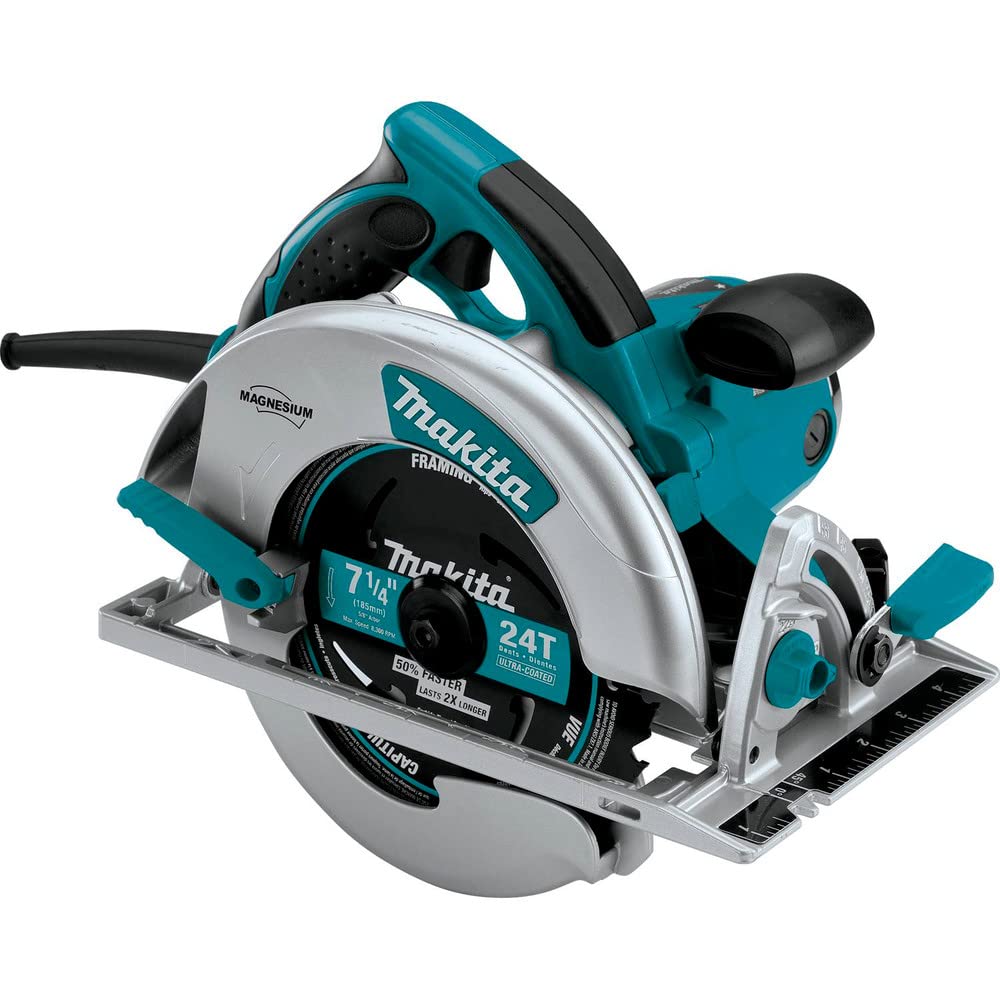
The Makita 5007MG delivers 5800 RPM, one of the highest speeds among corded sidewinders, paired with a rigid magnesium shoe for precise cuts in hardwoods. At 10.6 lbs it's heavier than the top pick, and some users find the lower guard can stick on bevel cuts. This saw suits professional framers and carpenters who value cut speed and durability over carrying a lighter tool.

💡 Tap the guard lever before starting a bevel cut to help ensure smooth retraction.

Pros

  • 5800 RPM motor powers through dense hardwoods without bogging down.
  • Magnesium shoe and blade guard reduce weight while adding rigidity and LED illumination.

Cons

  • Lower guard can stick during bevel cuts, requiring manual adjustment.
  • Weighs 10.6 lbs
Our verdict

For professionals who need maximum cut speed and a rigid platform, the added weight is a reasonable trade-off.

Check Latest Price
7

Efficient DIY

DEWALT DCS565B

93 /100
Craft Score Outstanding

Key details

Bevel
0-50°
Brake
Yes
Weight
6.3 lbs
Blade Size
6-1/2 in.
View on Amazon

This saw brings brushless motor efficiency and a blade brake to DEWALT’s 20V lineup, but the smaller 6-1/2-inch blade limits cut depth compared to full-size models, and the cost sits above budget cordless offerings. Best for those already invested in DEWALT batteries who prioritize compactness and modern features over maximum cutting capacity.

Pros

  • Brushless motor delivers good efficiency and power for light to medium tasks.
  • Integrated LED and electric brake improve visibility and safety during cuts.

Cons

  • Battery drain can be high with smaller battery packs, potentially limiting runtime.
Our verdict

A sensible upgrade for DEWALT users wanting brushless performance and a brake, as long as you have larger batteries or accept shorter runtimes.

Check Latest Price
8

Pro Cordless

DEWALT DCS578B

93 /100
Craft Score Outstanding

Key details

Bevel
57°
Brake
Yes
Weight
8.2 lbs
Blade Size
7-1/4 in.
View on Amazon

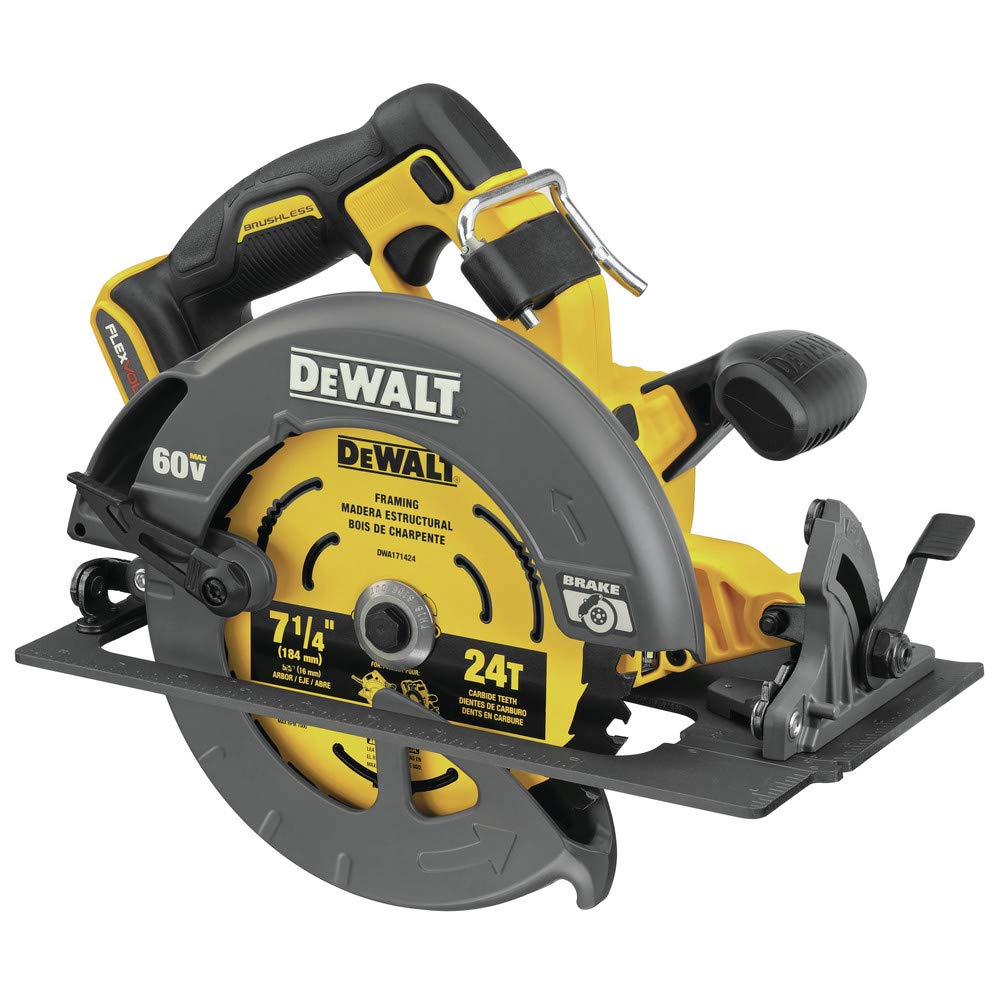
Corded-level power and cut quality in a cordless saw. The 60V brushless motor delivers 5800 RPM and a blade brake for precision. However, it requires FlexVolt batteries (not compatible with standard 20V) and is heavier than 20V alternatives — a premium investment best suited for professionals already in the FlexVolt system, not DIYers on a budget.

Pros

  • Corded-level power in a cordless design
  • Excellent cut quality and speed

Cons

  • Requires FlexVolt batteries
Our verdict

Best for professionals who already own FlexVolt batteries and need corded-level cutting power on the go. DIYers should look at 20V options or corded saws to avoid the platform investment.

Check Latest Price
9

Light Carpentry

Makita XSS02Z

94 /100
Craft Score Outstanding

Key details

Bevel
0-50°
Brake
No
Weight
7.3 lbs
Blade Size
6-1/2 in.
View on Amazon

This 6-1/2-inch cordless saw is well-balanced and lightweight, ideal for finish work and small projects. Its 3700 RPM motor handles softwoods and plywood without issue, but slows down on dense hardwoods. No blade brake or LED light means it's best suited for existing Makita battery owners who prioritize weight over advanced features.

Pros

  • Quality construction and reliable performance
  • Lightweight and well-balanced for easy handling

Cons

  • Lower RPM (3700) may struggle in dense hardwoods
Our verdict

Best for Makita LXT owners needing a lightweight saw for light-duty cuts; not for hardwoods or those wanting a blade brake.

Check Latest Price
10

Light Remodeling

Milwaukee 2630-20

91 /100
Craft Score Outstanding

Key details

Bevel
0-50°
Brake
No
Weight
7.3 lbs
Blade Size
6-1/2 in.
View on Amazon

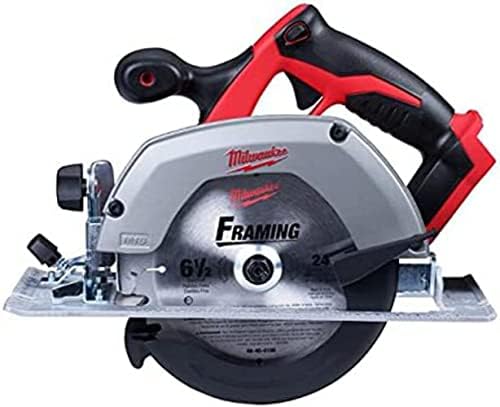
The Milwaukee 2630-20 delivers smooth, precise cuts with well-built magnesium guards, ideal for light framing and remodeling within the M18 battery system. Its 3500 RPM is lower than competitors and lacks a blade brake, so it suits occasional use rather than heavy hardwood cutting or safety-sensitive work.

Pros

  • Magnesium guards provide durability without adding weight.
  • Smooth and precise cuts for light construction tasks.

Cons

  • Lower RPM may underpower in hardwoods; no electric brake.
Our verdict

A good value for Milwaukee battery owners who need a light-duty saw for occasional cuts, but not for jobs requiring high power or a blade brake.

Check Latest Price
11

Light Household

Ryobi P505

92 /100
Craft Score Outstanding

Key details

Bevel
0-50°
Brake
No
Weight
4.1 lbs
Blade Size
5-1/2 in.
View on Amazon

At 4.1 lbs, the Ryobi P505 is the lightest circular saw at this price point. It cuts 2x4s and plywood without trouble, but the motor can stall on thicker lumber or dense materials. Battery life is short with standard packs, and there's no blade brake — fine for occasional DIY, not for production work.

Pros

  • Very lightweight at 4.1 lbs reduces fatigue during extended use
  • Budget-friendly entry price for Ryobi One+ battery owners

Cons

  • Motor can stall on thicker lumber, limiting cut capacity to light tasks
Our verdict

Best for Ryobi battery owners who need a budget saw for light trim work and hobby projects.

Check Latest Price

How to Choose

Motor Power

Motor power is typically measured in amps for corded saws (13A to 15A) and volts for cordless (18V to 60V). Higher amps mean more torque for dense lumber, but RPM also matters: 5000+ RPM produces cleaner cuts in hardwoods. For occasional use, a 13A motor is sufficient; for framing, a 15A motor is standard.

On cordless saws, voltage alone doesn't tell the full story. A brushless motor delivers more torque per watt and longer runtime than a brushed motor at the same voltage. A 20V brushless saw can match a 15A corded saw on most cuts, but the battery capacity (Ah) determines how long it lasts between charges.

Blade Size

Blade size determines the maximum cut depth. A 7-1/4-inch blade cuts through a 2x4 at a 90° angle in one pass; smaller blades like 6-1/2 or 4-1/2 inches require a second cut or can't handle thick lumber. If you only cut plywood or 1x stock, a smaller blade saves weight and improves maneuverability.

The trade-off is that smaller saws have limited bevel capacity and may struggle with pressure-treated lumber. For most DIY projects, a 7-1/4-inch saw is the safest choice. Upgrading the stock blade to a thin-kerf carbide model can also improve cut quality without changing the saw.

Corded vs Cordless

Corded saws deliver consistent power without battery anxiety, making them ideal for long sessions or heavy cutting. They're also cheaper and lighter than equivalent cordless models. The downside is limited range and the hassle of extension cords, especially on job sites or outdoor projects.

Cordless saws offer portability and convenience, but the total investment is higher once you factor in batteries and charger. For occasional use, a corded saw is better value. For professionals who move between work areas, a cordless saw with a 5Ah or larger battery can replace a corded saw for most tasks.

Weight

Weight directly affects user fatigue during extended cuts. A sidewinder around 8-9 lbs is comfortable for all-day use; worm-drive saws often exceed 11 lbs. Lightweight saws under 7 lbs excel for overhead or one-handed work but may sacrifice stability and torque. Consider your typical cutting height and duration.

Bevel Capacity

Bevel capacity lets you cut angled edges without a separate tool. 45° is standard for most framing and trim work; 50° to 57° allows for steep compound cuts. If you frequently cut rafters or crown molding, a saw with at least 50° bevel is useful. Bevel detents at common angles speed up adjustments.

Note that bevel capacity is often less when using the full cut depth. A saw that bevels to 57° at 90° cut may only reach 45° at max depth. Check the manual for the actual working range.

Electric Brake

An electric brake stops the blade within seconds of releasing the trigger, reducing the risk of kickback injuries and allowing faster work sequences. Budget saws often omit this feature, letting the blade coast for several seconds. For safety-conscious users, a brake is a worthwhile upgrade. Some cordless saws have a soft-start feature that reduces startup torque, adding control.

Frequently Asked Questions