12 Best Drill Guides of 2026: Drill‑Press Accuracy in a Portable Package

Which drill guides keep bits dead‑straight on flat stock, round stock, and edges — for woodworkers and DIYers who need drill‑press accuracy without the bulk.

A wonky hole can ruin a mortise, shelf pin, or cabinet door alignment, yet a full‑size drill press is overkill for many woodshops. A portable drill guide bridges that gap — if you pick one with hardened bushings and a design that rewards clamping, not hand‑holding.

The difference between a true straight‑hole aid and a wobbly block comes down to materials and geometry. The best guides use heat‑treated steel bores, feature deep V‑grooves for round stock, and cover enough common sizes to match your bit set. Choose wisely, and you’ll drill like you’re on a press.

Pocket‑hole jigs get the headlines, but if you mostly need perfectly perpendicular holes for dowels, shelf pins, or hardware, a simple V‑drill guide often outperforms complex attachments. The key is ignoring marketing promises and checking the hardness of the guide bores — soft aluminum or plastic will wear fast, reintroducing the same angle error you set out to eliminate.

1

Best Overall

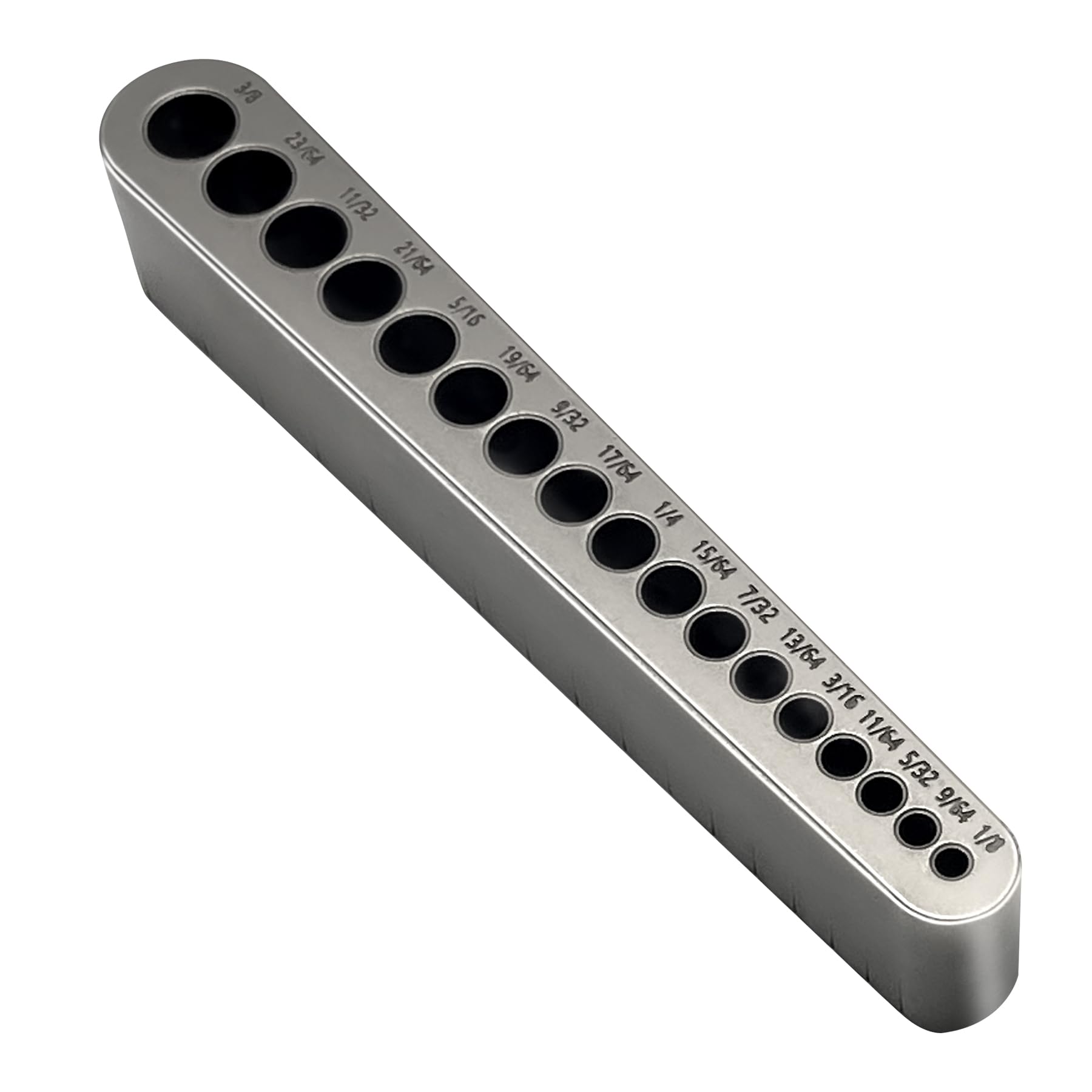
Big Gator V‑DrillGuide

95 /100
Craft Score Outstanding

Key details

Versatility
V‑groove for round stock, flat base
Compatibility
Standard bits up to 3/8"
Bushing Material
Hardened steel
Drill Guide Sizes
17 sizes, 1/8"–3/8", 1/64" increments
View on Amazon

Seventeen hardened-steel guide sizes, machined in 1/64-inch increments from nickel alloy steel, cover 1/8 to 3/8-inch bits and hold tight tolerances for perpendicular holes on flat stock, edges, and round bar. The V-groove centers the work on round materials, and the ground flat base sits securely on benchtops. Clamping is essential—the guide must be secured to the workpiece with a quick-clamp, as hand-holding may allow drift on slick woods. With that setup, the tool delivers drill-press accuracy and stands up to years of shop use, backed by a lifetime warranty.

This guide is for woodworkers, metalworkers, and committed DIYers who need portable perpendicular drilling without a dedicated drill press. It is not designed for pocket-hole joinery, angled holes, or anyone hoping to skip clamping—the tradeoff for its precision and 17-size convenience is an unconditional clamp requirement. For those willing to secure it firmly, the Big Gator pays for itself by eliminating rework from crooked holes.

💡 Use a quick-clamp or bar clamp to hold the guide firmly; even a small squeeze clamp keeps it from drifting on slick woods.

Pros

  • Heat-treated nickel alloy steel stands up to years of demanding shop use.
  • Delivers dead-on perpendicular holes, even on round stock and edges.
  • Seventeen guide sizes in 1/64-inch increments cover 1/8-inch to 3/8-inch bits.

Cons

  • Clamping is mandatory; hand-holding may cause misalignment on slick woods or small workpieces.
Our verdict

For woodworkers and metalworkers who accept the clamp requirement, this lifelong V-block guide pays for itself in eliminated crooked holes.

Check Latest Price
2

Best Budget Straight Drill Block

Milescraft 1312 Drill Block

93 /100
Craft Score Outstanding

Key details

Versatility
V‑groove, flat stock, no angled holes
Compatibility
Handheld drills, bits up to 1/2"
Bushing Material
Steel sleeves (plastic body)
Drill Guide Sizes
6 sizes, 1/8"–1/2"
View on Amazon

Priced far below hardened-steel V-blocks, the Milescraft Drill Block provides six steel guide sizes — 1/8 inch to 1/2 inch — for drilling perpendicular holes in flat and round stock. The bushings are slightly oversized, creating some bit wobble that limits precision for tight joinery, but the non-slip feet and alignment marks keep the tool steady during casual use.

It's built for DIYers and homeowners who need a handful of straight holes per project and aren't chasing drill-press tolerances. For furniture joinery requiring exact diameters, the top pick's seventeen hardened-steel guides and lifetime warranty justify the higher spend.

💡 Test on scrap before final holes — the slight play in the guides can lead to holes a hair larger than the bit size.

Pros

  • Straight, perpendicular holes without guesswork.
  • The least expensive way to replace eyeballing with a guide.
  • No setup required

Cons

  • Guide bushings are slightly oversized, causing bit wobble that reduces accuracy for tight-tolerance holes.
Our verdict

At its low price, it's the most accessible way to drill perpendicular holes without a drill press. If you need precision for fine joinery, the top pick's tighter tolerances are worth the extra money.

Check Latest Price
3

Best Pocket‑Hole Joinery System

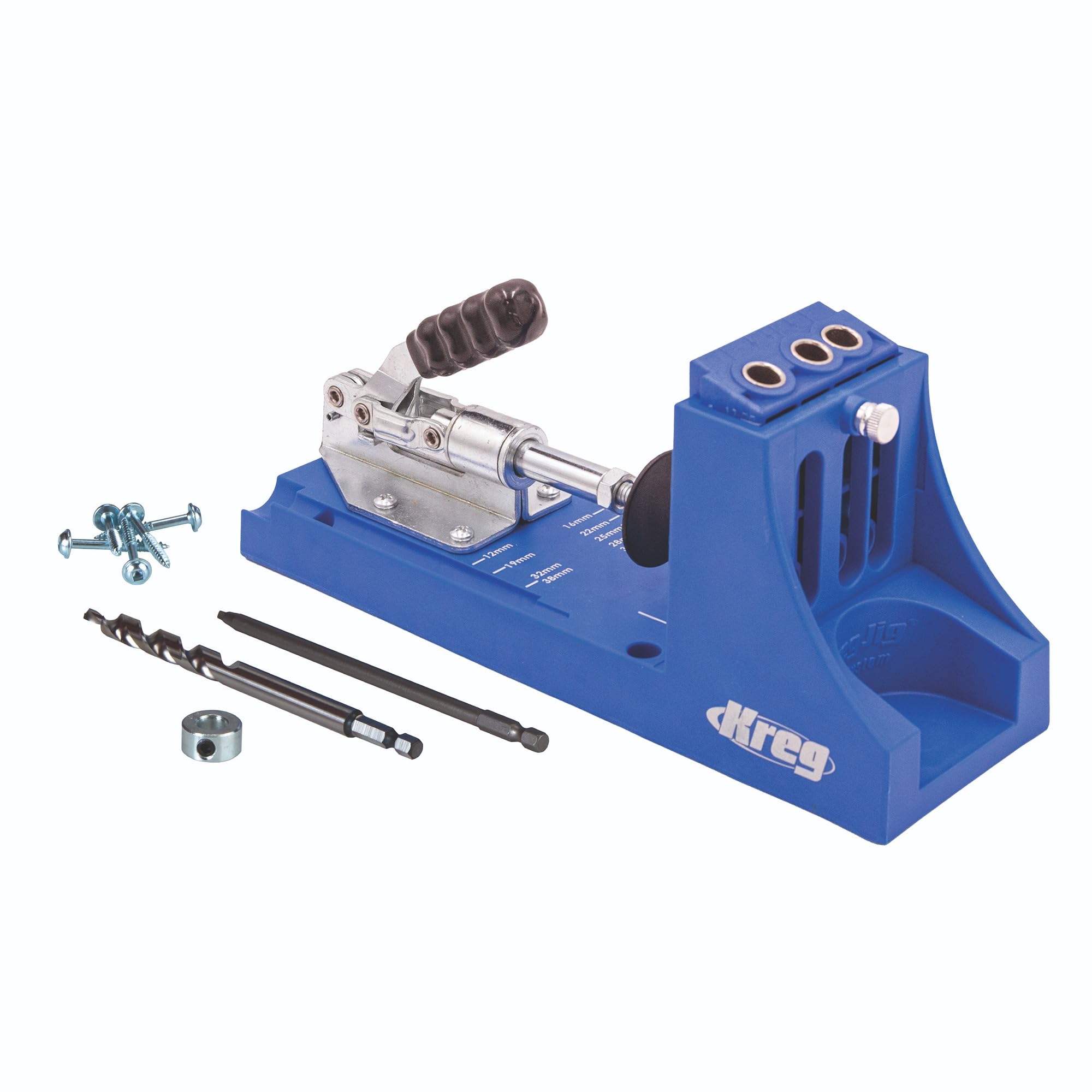
Kreg K4 Pocket Hole Jig

96 /100
Craft Score Outstanding

Key details

Versatility
Pocket‑hole joinery
Compatibility
Kreg stepped bit, standard drill
Bushing Material
Hardened steel
Drill Guide Sizes
View on Amazon

Unlike general-purpose drill guides, the K4 is a dedicated pocket-hole jig built around a toggle-clamped three-guide system that produces repeatable angled pockets in stock from 1/2 to 1-1/2 inches. It's designed for strong hidden joinery in furniture and cabinets, not for drilling straight holes or shelf pins.

Serious DIYers and woodworkers who value speed and joint consistency will find it worth the premium. The stock drill bit can dull under heavy hardwood use, so having a spare on hand is sensible. For occasional pocket holes or general drilling, a simpler, less expensive guide may be a better fit.

Pros

  • Rugged construction stands up to frequent shop use
  • Intuitive toggle clamp and alignment guides make setup fast for beginners
  • Produces repeatable pocket holes that yield strong, tight-fitting joints

Cons

  • The included bit may dull or chip after extended hardwood use; replacement bits add cost
Our verdict

For woodworkers building furniture and cabinets, this jig pays for itself in saved time and consistent results. Those who only need straight holes or an occasional pocket joint can get by with a less specialized tool.

Check Latest Price
4

Best Shelf‑Pin Jig

Kreg Shelf Pin Jig

94 /100
Craft Score Outstanding

Key details

Versatility
Shelf pin holes in cabinets
Compatibility
Included 1/4" bit
Bushing Material
Hardened steel insert
Drill Guide Sizes
1/4" single size
View on Amazon

The edge-aligned design delivers uniform 1/4-inch pin holes with minimal setup, cutting layout time on bookcases and kitchen cabinets. Its compact size works inside assembled cabinets without removing shelves. Cabinet makers and DIYers upgrading pantry storage will find it practical, though a quick test on scrap material is wise to catch any rare spacing inconsistencies before drilling into finished panels.

💡 Test hole spacing on scrap material before committing to a full run.

Pros

  • Cuts layout time with uniform shelf-pin holes in one pass.
  • Compact enough to use inside existing cabinets without removing shelves.
  • Delivers professional-grade results on bookcases and kitchen cabinets.

Cons

  • Hole spacing may be vertically asymmetric; testing on scrap material before drilling is a wise precaution.
Our verdict

A practical, affordable jig for 1/4-inch shelf-pin projects that rewards a quick trial run before drilling into finished panels.

Check Latest Price
5

Best Cabinet Hardware Jig

King&Charles Cabinet Jig

90 /100
Craft Score Outstanding

Key details

Versatility
Cabinet knobs and pulls
Compatibility
3 included point‑wood bits
Bushing Material
Plastic (ABS)
Drill Guide Sizes
3mm, 4mm, 5mm bits
View on Amazon

Where the top pick is a general-purpose straight-hole guide for precise woodworking, this King&Charles jig focuses on one task: drilling consistent holes for cabinet knobs and pulls. The dual metric/imperial scales and quick-release sliders remove the guesswork from spacing, while the included automatic center punch eliminates wandering bits. Everything needed comes in the box — three point-wood bits cover common hardware sizes, so there's no need to hunt for accessories. The ABS body is light but holds up for DIY kitchen and bath updates; daily pro use will wear it out faster, but that's not the intended audience.

Pros

  • Makes knob and pull installation quick and repeatable
  • All-in-one value with center punch, three bits, and dual-scale jig
  • Simple setup that requires no prior experience

Cons

No notable drawbacks to flag.

Our verdict

For under $10, this jig turns the tedious task of aligning cabinet hardware into a quick, repeatable process — ideal for anyone refreshing a kitchen or bathroom on a weekend.

Check Latest Price
6

Best Budget Doweling Jig

BLEKOO Doweling Jig

87 /100
Craft Score Excellent

Key details

Versatility
Dowel joinery
Compatibility
Standard drill bits
Bushing Material
Hardened steel
Drill Guide Sizes
3 sizes: 1/4", 5/16", 3/8"
View on Amazon

The BLEKOO doweling jig pairs a rigid aluminum body with six steel bushings (1/4', 5/16', 3/8') and fits boards up to 2.4 inches wide, putting basic dowel joinery within reach of hobby budgets. Its self-centering mechanism can be off by up to 1/32'—dialing in alignment on a test piece eliminates guesswork. This fits occasional furniture repair or learning the technique, not production work where perfect centering is non-negotiable.

💡 Take a test piece of scrap wood before each project to adjust centering.

Pros

  • Affordable entry into dowel joinery without a dedicated machine.
  • Aluminum body feels sturdy and stable during drilling.
  • Simple to operate for basic doweling tasks.

Cons

  • Self-centering may drift, leaving holes up to 1/32' off center
Our verdict

This jig makes dowel joinery affordable for hobbyists who don't mind calibrating centering on scrap before each session.

Check Latest Price
7

Small Crafts Drilling

Dremel 220‑01 Workstation

93 /100
Craft Score Outstanding

Key details

Versatility
0°–90° horizontal, small crafts
Compatibility
Dremel rotary tools
Bushing Material
Drill Guide Sizes
View on Amazon

The Dremel 220-01 Workstation securely mounts a compatible rotary tool, providing a vertical stand for straight and angled drilling on small craft pieces. The carriage has noticeable play, so it won't deliver the repeatable accuracy of a full drill press. This slack is tolerable for jewelry, model-making, or light woodworking where slight deviations don't ruin the project.

Pros

  • Mounts a Dremel securely in a stand for vertical and angled drilling of small workpieces.
  • Lets you drill at angles from 0° to 90° in 15° steps for crafts and jewelry.

Cons

  • Carriage wobble prevents repeatable precision
Our verdict

A fit for Dremel owners who need a hands-free stand for occasional small-hole drilling in crafts or models, where exact positioning is not the top priority.

Check Latest Price
8

Angled Drilling

VastHome Angle Drill Guide

85 /100
Craft Score Excellent

Key details

Versatility
30°, 45°, 90° angled drilling
Compatibility
Standard bits
Bushing Material
Aluminum
Drill Guide Sizes
4 sizes: 3/8", 5/16", 1/4", 3/16"
View on Amazon

Drilling angled pilot holes for cable railing and deck hardware is far cleaner with this guide than by eye. The aluminum body feels solid and includes four bits. This is a short-term solution suited for a single project; beyond that, you'll want a more durable guide.

Pros

  • Clean angled holes for railing and deck hardware without freehand guesswork.
  • Solid aluminum body with onboard bit storage keeps the kit organized.

Cons

  • Aluminum bushings can soften after roughly 50 holes, gradually reducing angle accuracy.
Our verdict

A practical choice for one railing or deck project where a few dozen angled holes are all you need.

Check Latest Price
9

Dust‑Collection Pocket‑Hole

GOINGMAKE Pocket Hole Jig

89 /100
Craft Score Excellent

Key details

Versatility
Pocket‑hole joinery, dust collection
Compatibility
Pocket‑hole bit, standard drill
Bushing Material
Hardened steel
Drill Guide Sizes
View on Amazon

The jig's all‑metal construction and integrated dust collection make pocket‑hole joinery cleaner at the bench. However, the overall experience hinges on swapping out the included bits — budget for aftermarket ones and the tool shines.

Pros

  • All‑metal body and steel guide inserts feel more durable than plastic pocket‑hole jigs.
  • Integrated dust collection port keeps the work area noticeably cleaner.

Cons

  • Included step drill bits can snap at the pilot tip early on, requiring an immediate aftermarket replacement.
Our verdict

For DIYers ready to discard the bits right out of the box and use quality aftermarket ones, the jig’s robust metal construction and dust collection make it a worthwhile pocket‑hole station.

Check Latest Price
10

Rigid Shelf Pins

GOINGMAKE Shelf Pin Jig

92 /100
Craft Score Outstanding

Key details

Versatility
Shelf pins, no angled holes
Compatibility
1/4" bits
Bushing Material
Hardened steel
Drill Guide Sizes
1/4" single size, 7 holes
View on Amazon

The GOINGMAKE jig’s aluminum body and seven hardened steel bushings make quick work of repetitive shelf-pin drilling, and it costs less than many plastic five-hole jigs. The strictly 1/4" sizing rules out 5mm hardware — a tradeoff that favors cabinetmakers already working in imperial measurements, who gain a more solid tool than plastic rivals.

Pros

  • All-metal construction holds up to repeated clamping without flexing
  • Seven aligned guide holes let you drill an entire shelf side in one setup

Cons

  • Limited to 1/4" pin holes
Our verdict

For those building adjustable shelving with 1/4" pins, this aluminum jig delivers speed and durability at a compelling price — just be sure your hardware matches.

Check Latest Price
11

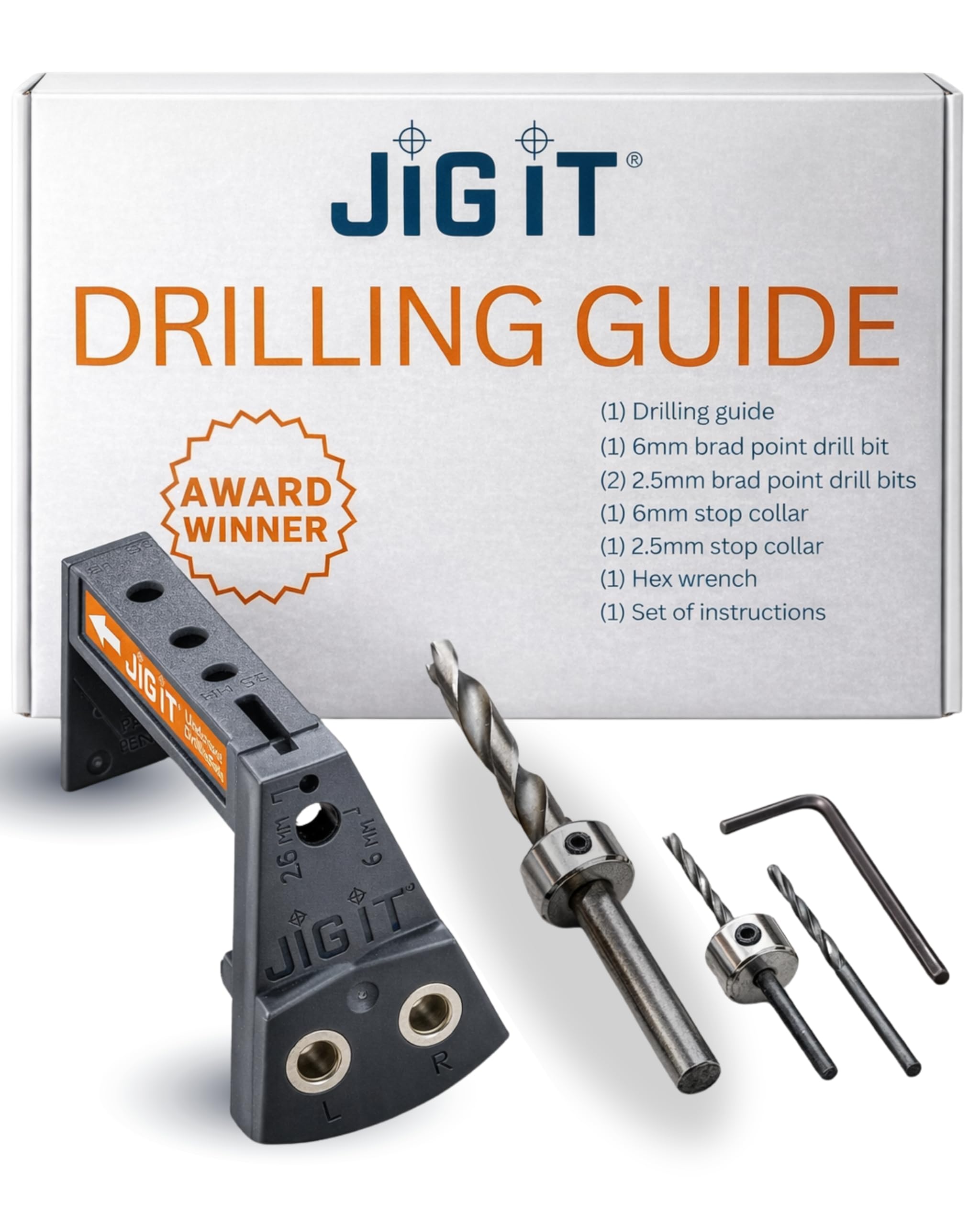
Blum Undermount Slides

Rockler Undermount Drill Guide

90 /100
Craft Score Outstanding

Key details

Versatility
Blum undermount slide installation
Compatibility
Blum Tandem plus slides
Bushing Material
ABS with steel inserts
Drill Guide Sizes
6mm, 2.5mm brad point bits
View on Amazon

The jig positions a 6mm and 2.5mm brad point bit at the precise angle Blum Tandem plus slides require. Steel inserts in the ABS body resist wear, and stop collars prevent tear-out. It eliminates layout errors for that hardware, but has no function outside that ecosystem. It justifies its cost only if you build drawers with these slides repeatedly.

Pros

  • Takes the trial-and-error out of Blum Tandem slide mounting, saving expensive drawer boxes.
  • Accelerates production of multiple drawers with identical, repeatable hole placement.

Cons

  • Only works with Blum Tandem plus slides; other undermount hardware receives no benefit.
Our verdict

If your workflow revolves around Blum Tandem plus slides, this jig reliably removes the risk of hole misalignment; for any other drawer hardware, skip it.

Check Latest Price
12

17‑Size V‑DrillGuide

TJCYGO V‑DrillGuide

88 /100
Craft Score Excellent

Key details

Versatility
V‑groove, flat stock, no angles
Compatibility
Standard bits up to 3/8"
Bushing Material
Heat‑treated steel
Drill Guide Sizes
17 sizes, 1/8"–3/8", 1/64" increments
View on Amazon

The TJCYGO V‑DrillGuide replicates the Big Gator’s 17‑size V‑block in heat‑treated steel, with a heavy base that clamps securely. It drills straight holes on flat and round stock. The lifetime replacement policy provides a real backstop, but long‑term durability is less clear than the original, so it suits those who prioritize warranty coverage over a long track record.

Pros

  • Heavy, solid-feeling steel guide that stays put when clamped
  • Drills straight holes on flat and round stock, good for smaller bits

Cons

  • Long-term durability under heavy use is less certain than the Big Gator original
Our verdict

Budget-conscious woodworkers who want the 17-size V-drill concept and can accept less certainty about long-term wear get a solid steel guide with a lifetime guarantee.

Check Latest Price

How to Choose

Drill Guide Sizes and Increments

A guide with only four or five common sizes covers your most‑used bits, but a set with 17 sizes in 1/64‑inch increments lets you match virtually any fractional drill bit. If you regularly drill pilot holes for specific screw sizes or need exact clearance for dowels, the larger range eliminates bit‑guide play that causes off‑center starts.

Oversized holes are a hidden problem — guides that aren’t precisely ground can allow the bit to wobble even in the right size, so hardened steel and tight tolerances are just as important as number of sizes.

Bushing Material

Soft aluminum or plastic bushings may start smooth, but they deteriorate quickly, enlarging the hole guide and introducing play that ruins precision. Hardened steel bushings hold their shape under the friction of hundreds of holes, maintaining alignment. The best guides use heat‑treated nickel alloy steel that won’t burr or deform.

Clamping Mechanism

Even the most precise guide will wander if it slips on the workpiece. A built‑in toggle clamp locks the jig instantly, but many portable guides rely on you to supply a separate clamp. A guide with a ground flat base and large surface area offers better resistance to slipping when clamped, while narrow blocks can rock on narrow stock. The rule: never hand‑hold — clamping is non‑negotiable for repeatable accuracy.

Versatility for Round Stock and Angled Holes

If you drill into dowels, pipes, or corners, a V‑groove in the base of the guide automatically centers the bit on round stock. Some guides only handle flat faces. For angled holes, a dedicated angle guide with 30°, 45°, and 90° settings is essential, but these often sacrifice bit‑size range. Consider how much of your work involves compound angles before buying a specialty tool.

Compatibility with Your Drill

Most drill guides accept standard twist bits up to 3/8" or 1/2", but pocket‑hole jigs require a specialized stepped bit that drills the pilot hole and countersink in one pass. If you plan to use a guide with a cordless drill, check that the guide’s shaft clearance fits your chuck. Long bits may bottom out in shallower guides, leaving a chatter‑prone overhang. A guide with a generous height accommodates longer bits without binding.

Frequently Asked Questions