6 Best Dovetail Marking Guide 2026: Stable, Accurate Layouts for Woodworking

Which dovetail markers actually stay stable and mark clearly without constant adjustment or faint lines. Find the right tool for your joinery.

Many dovetail markers arrive with promises of precision, but users quickly discover faint rod markings or locking knobs that slip mid-cut. The result is wasted stock and frustrated plans.

A simple, large-body marker often delivers more stable registration than a complex wheel gauge set. But if you need integrated scribing for hardwoods, a wheel gauge saves a separate tool. The tradeoff is between pure simplicity and added versatility.

This guide focuses on markers that hold their setting, read clearly in any light, and match the joints you actually cut - so your dovetails come out tight on the first try.

1

Best Overall

Clarke Brothers Marker

91 /100
Craft Score Outstanding

Key details

Material
Anodized aluminum
Scribe Gauge
No
Marking Readability
Clear engraved
Body Size & Ergonomics
Extra-large, 3.52 oz
View on Amazon

The Clarke Brothers Dovetail Marker achieves what many compact markers cannot: a body large enough to register firmly against the work piece without slipping, even during one-handed operation. The anodized aluminum body provides a confident grip, and the four slope ratios (1:5, 1:6, 1:8, 1:10) cover the full range of softwood and hardwood dovetail layouts without needing to flip the tool.

This is a pure marker — no wheel scribe, no integrated gauge. If your workflow depends on a scribe for baseline layout or a wheel cutter for depth lines, you will need a separate tool. That tradeoff is straightforward: you get exceptional stability and simplicity in exchange for a single-purpose design. The large body also means it takes up more bench space than a pocket-sized model, but for anyone who prioritizes accuracy over portability, the tradeoff is worthwhile.

Pros

  • Large ergonomic body provides stable marking without slipping, even one-handed.
  • Extremely easy to use and highly accurate with all four common slopes.
  • Great value with four slopes at a budget price, no functional complaints reported.

Cons

  • Lacks a wheel scribe or integrated gauge; requires a separate marking gauge for baseline layout.
  • Large body occupies more bench space and is less suited for tight storage or travel.
Our verdict

A dovetail marker that does one thing very well: stable, accurate layout with no frills. Best for woodworkers who already own a marking gauge and want a tool that simply works.

Check Latest Price
2

Best Budget Marker

Newkiton Dovetail Marker

89 /100
Craft Score Excellent

Key details

Material
Aluminum
Scribe Gauge
No
Marking Readability
Clear engraved
Body Size & Ergonomics
Compact, 2.91 x 1.13 in
View on Amazon

This 1 oz aluminum marker packs all four common slope ratios (1:5, 1:6, 1:8, 1:10) at the lowest price point, making it an accessible entry into dovetail marking. It marks accurately on straight layouts, but inside angles may require flipping the tool to cover both face and edge — a minor adjustment for occasional use. Best suited for beginners on a tight budget or woodworkers needing a compact marker for quick layouts.

💡 For inside angles, flip the marker to mark the edge line after the face line to avoid awkward repositioning.

Pros

  • Four common slopes in a lightweight 1 oz aluminum body at a budget price.
  • Easy to use and provides accurate layout lines for beginners and experienced users.

Cons

  • Inside angles can be awkward to use; may require repositioning to mark both face and edge.
Our verdict

A low-cost marker that delivers all common slopes — practical for beginners and occasional use.

Check Latest Price
3

Best Dovetail Marking Set

YOSELIN Dovetail Marking Set

90 /100
Craft Score Outstanding

Key details

Material
Brass + aluminum + stainless
Scribe Gauge
Yes
Marking Readability
Clear engraved
Body Size & Ergonomics
Standard, 8-inch rod
View on Amazon

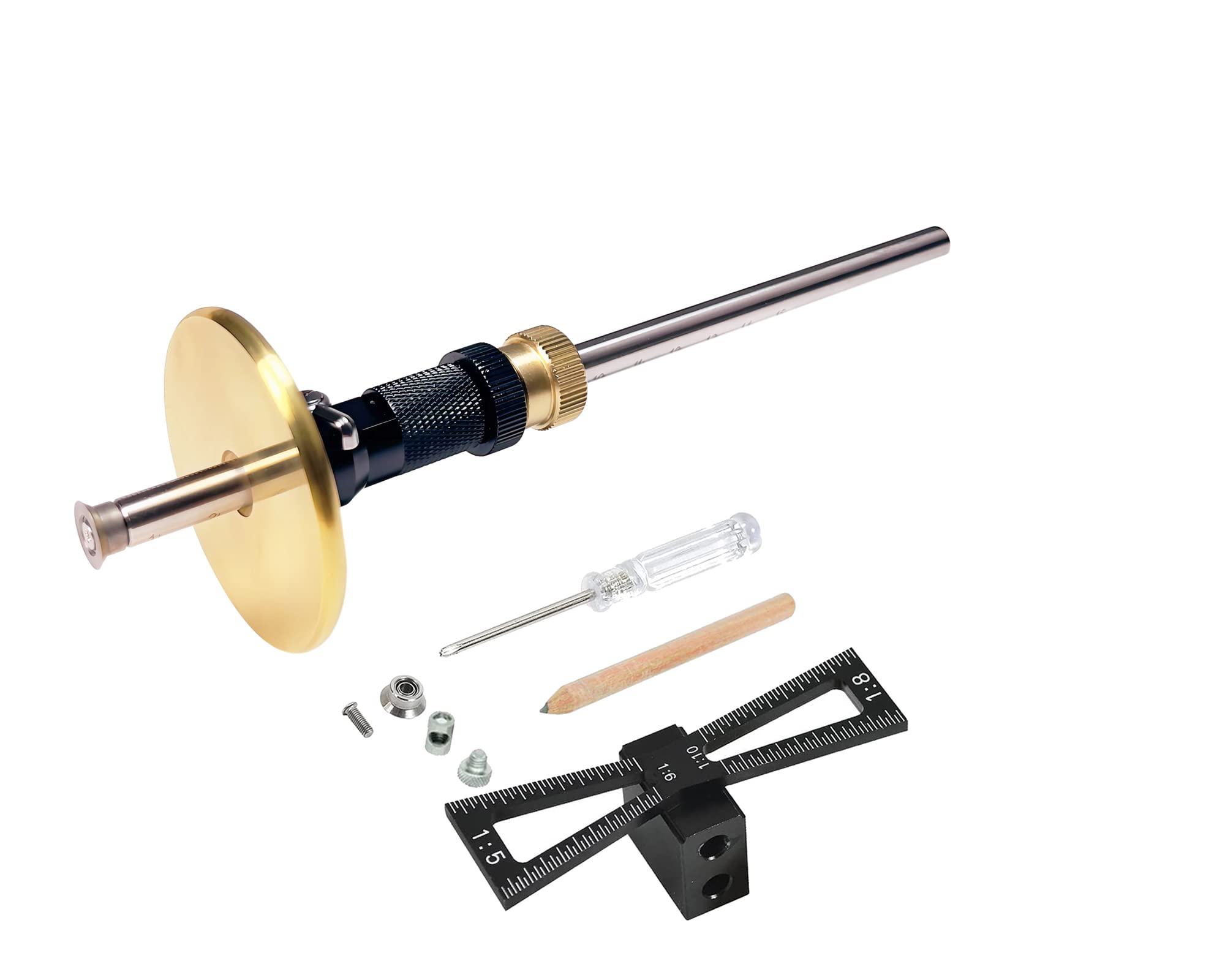
The YOSELIN set gives you a bearing wheel cutter for softwood and a locked wheel cutter for hardwood, so you don't need separate tools for different wood densities. A pencil and screwdriver are included for marking and adjustments. Compared to the precision micro-adjustment gauge, this set sacrifices fine adjustment for a complete kit. It's a good fit for woodworkers who value dedicated cutters and don't mind the occasional need to re-tighten the locking knob during extended use.

Pros

  • Dual cutters let you switch between softwood and hardwood without buying additional tools.
  • Complete set includes pencil and screwdriver, saving separate purchases.

Cons

  • Locking knob can loosen during use, requiring periodic re-tightening.
Our verdict

A well-rounded set for woodworkers who want dedicated cutters and accessories in one package — minor knob adjustment is a manageable tradeoff.

Check Latest Price
4

Best for Precision Marking

YOSELIN Micro-Adjust Set

86 /100
Craft Score Excellent

Key details

Material
Aluminum + copper + stainless
Scribe Gauge
Yes
Marking Readability
Clear engraved
Body Size & Ergonomics
Extra-heavy, 1.15 lb
View on Amazon

Dual-stage micro and coarse adjustment, paired with a heavy brass face, delivers smooth and stable marking for fine repeatable layouts. This set includes one cutter and a pencil, focusing on precision over breadth. At 1.15 lb, the weight suits a stationary workshop where stability matters more than portability. Ideal for enthusiasts and professionals who need fine-tuning capability and don’t mind the heft.

Pros

  • Micro-adjustment enables precise, repeatable marking for complex joinery.
  • Solid brass face and retractable cutter add durability and safe storage.

Cons

  • At 1.15 lb, the weight is noticeable for portable use or quick marking tasks; less of an issue in a stationary workshop.
Our verdict

This set justifies its premium price for serious woodworkers who need micro-adjust precision; those with simple projects may find it overbuilt.

Check Latest Price
5

Occasional Use

Big Horn Dovetail Marker

80 /100
Craft Score Excellent

Key details

Material
CNC-machined aluminum
Scribe Gauge
No
Marking Readability
White gradations on black
Body Size & Ergonomics
Small, 2.5 x 1.9 x 0.8 in
View on Amazon

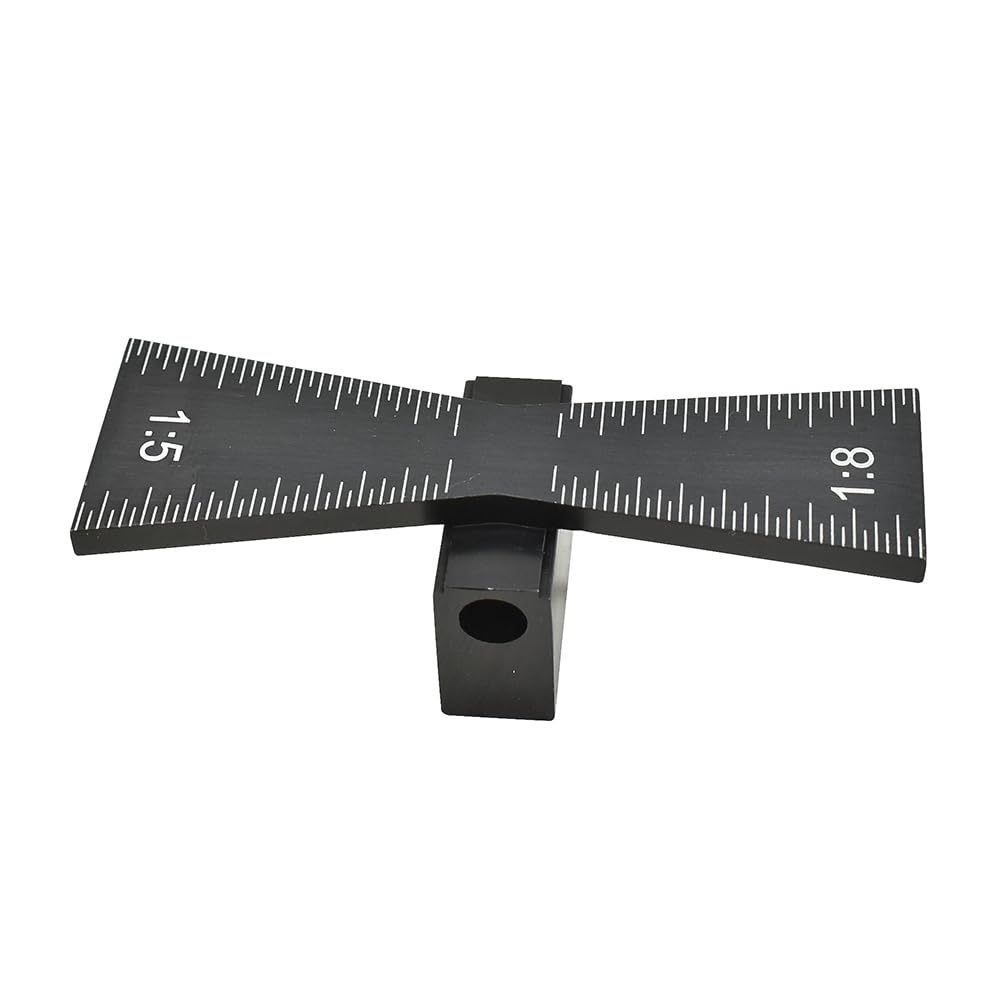
This compact aluminum marker offers clearly visible white graduations and a small footprint. It includes only 1:5 and 1:8 slopes, not the standard 1:6 or 1:10 — suitable for occasional, non-versatile joinery on a tight budget.

Pros

  • Compact and lightweight with clearly visible white graduations.
  • Affordable price for woodworkers on a tight budget.

Cons

  • Only two slope ratios (1:5 and 1:8)
Our verdict

Best for woodworkers who only need 1:5 and 1:8 slopes and want the lowest-cost dovetail marker.

Check Latest Price
6

Generies 14-Piece Set

85 /100
Craft Score Excellent

Key details

Material
Metal
Scribe Gauge
Yes
Marking Readability
Body Size & Ergonomics
Bulk, 14 oz set
View on Amazon

This 14-piece set bundles ten marking pencils, a woodworking pencil, a metal scriber, and a wheel gauge. The core dovetail marking function lacks confirmed slope ratios or accuracy specs, making it unclear whether the gauge matches common 1:6 or 1:8 layouts. If you primarily need pencils and a scriber with a gauge as a bonus, it may suffice; for precise dovetail marking, consider a dedicated marker.

Pros

  • Bundle includes 10 marking pencils for easy replacement during layout work.
  • Metal scriber offers an alternative marking tool alongside the pencils.

Cons

  • Dovetail slope ratios and gauge accuracy are not specified, so compatibility with common angles is uncertain.
Our verdict

This set works if your priority is a pencil and scriber assortment rather than documented dovetail angles. For precise marking, pick a dedicated marker.

Check Latest Price

How to Choose

Slope Ratios

Slope ratios (like 1:6 or 1:8) define the angle of the dovetail. A 1:6 slope is steeper and works well for softwoods; 1:8 is shallower and better for hardwoods. Most woodworkers need at least three ratios to cover different wood types and joint appearances.

Markers with only two slopes limit your options. If you work with both pine and oak, a four-slope marker (1:5, 1:6, 1:8, 1:10) gives the flexibility to match wood density and project style.

Material & Build

Aluminum markers are lightweight and corrosion-resistant, but brass or stainless steel adds weight and rigidity. Heavier tools feel more planted during marking, reducing the chance of slipping off the layout line.

Anodized finishes resist wear better than raw aluminum. For wheel gauges, brass or steel cutters last longer and produce cleaner scribe lines than softer alloys.

Ergonomics & Body Size

A larger body provides more surface area to register against the wood, which improves accuracy. Extra-large markers like the Clarke Brothers give a stable reference without requiring precise finger pressure.

Compact markers are portable and easier to store, but they demand more careful alignment. For repetitive layout work, a heavier, larger tool reduces fatigue and error.

Scribe Gauge vs. Simple Marker

Wheel marking gauges combine a scribe and a depth stop in one tool, letting you mark both the baseline and the dovetail angle in one pass. This speeds up workflow but introduces a locking mechanism that can loosen during use.

Simple markers are purely angle guides - you still need a separate marking gauge or knife for the baseline. They are less convenient but have fewer moving parts to fail, making them more reliable for occasional users.

Marking Readability

Engraved markings that are filled with paint or laser-etched remain visible for years. Painted-on graduations wear off with use, especially on rods that slide against the body.

Bright contrast (white on black or black on brass) helps readability in workshop lighting. Faint or shallow engravings force you to squint and can slow down layout significantly.

Frequently Asked Questions