10 Best Doweling Jig of 2026: Self-Centering That Doesn't Drift

Which self-centering doweling jigs actually drill dead-center holes for flush furniture joints, and which metal clamping models reward careful setup.

A phrase that sounds reassuring — 'self-centering' — often leads to frustration when a doweling jig’s holes come out 1/32 inch off and the joint won’t sit flush. Many jigs, especially at lower prices, rely on spring-loaded plastic pins and plastic bodies that flex under a drill’s torque. That tiny bit of play translates to visible misalignment in a finished cabinet or tabletop.

Here’s which doweling jigs actually deliver true centering, time after time, so your dowels line up and your panels come together tight. The practical trade-offs — a clamping jig for production work, a complete kit to avoid scrounging for bits, or a lightweight budget model for occasional use — all find a place in this lineup.

The good news: there are several metal-bodied options that approach near-perfect repeatability without costing a fortune, and a few starter kits that teach you the method with everything in one box. The trick is matching the jig’s precision and durability to the kind of projects you actually build.

1

Best Overall

Dowl-it 1000

93 /100
Craft Score Outstanding

Key details

Body Material
Solid steel
Board Thickness
Up to 2″
Clamping Mechanism
Handheld (no clamp)
Included Accessories
Jig only
View on Amazon

The Dowl-it 1000 drills dead-center holes every single time. Its all-steel body and hardened bushings eliminate the flex and drift that cause misalignment in plastic jigs, guaranteeing precise dowel placement without any slop. This is not a kit of compromise parts — it’s a single, beautifully machined tool that self-centers on any board up to 2 inches thick.

The heft and seamless action make it feel like a machine-shop instrument. There’s no plastic to crack, no bushings to egg out, and no play in the centering mechanism. For professional cabinetmakers and serious joinery specialists, that translates to joints that close tight without sanding or persuasion. Daily commercial use is exactly what it’s built for.

The trade-off: this jig is a bare tool. Drill bits, dowels, and depth stops are sold separately, so you must source your own. That adds cost and a few minutes of setup, which casual DIYers who only tackle a couple of projects may find hard to justify. But if you’ve ever fought a misaligned budget jig, the Dowl-it 1000 is a one-time purchase that ends that frustration permanently.

💡 Plan to purchase high-quality brad-point bits and depth stops separately — pairing them with this jig unlocks its full precision potential.

Pros

  • Dead-center holes with zero alignment drift, guaranteeing tight dowel joints every time.
  • Solid steel construction and hardened bushings that withstand daily professional use without wear.
  • Precision mechanism with no slop or play, providing confident, repeatable action.

Cons

  • No storage case included
  • Drill bits, dowels, and depth stops are sold separately, adding cost and setup time.
Our verdict

For professional woodworkers and dedicated hobbyists, the Dowl-it 1000 is the last doweling jig you’ll buy. It expects you to bring your own bits, but it repays that with flawless alignment and heirloom durability that no plastic jig can touch.
Check Latest Price
2

Best Self-Clamping Metal Jig

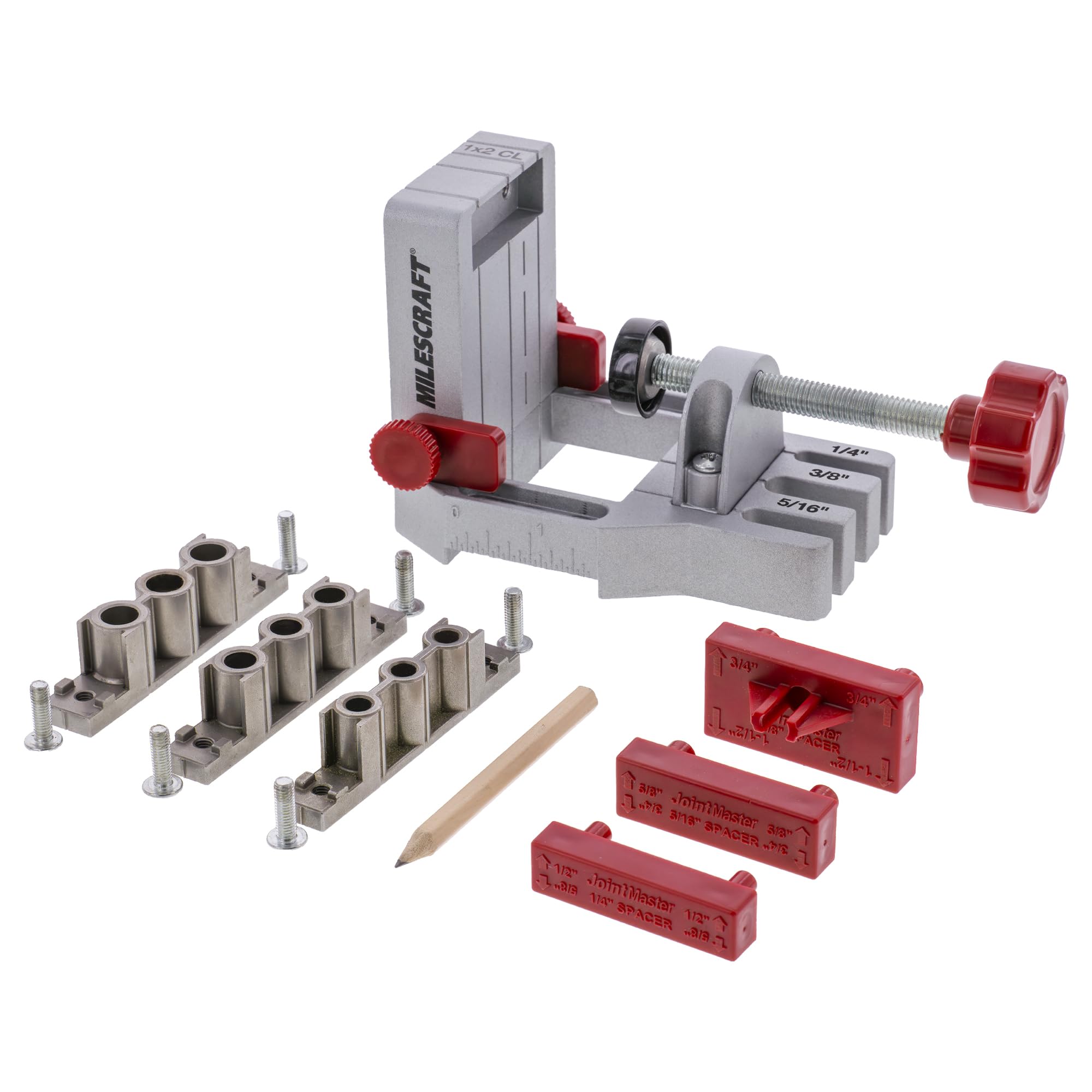
Milescraft 1334 Joint Master

91 /100
Craft Score Outstanding

Key details

Body Material
Aluminum
Board Thickness
Up to 1-3/4″
Clamping Mechanism
Built-in self-clamping
Included Accessories
Jig only (no bits)
View on Amazon

Built-in clamp and all-aluminum body give you rock-solid stability without extra tools, setting the Joint Master apart from handheld plastic kits. Unlike the all-in-one starter kit that bundles bits and glue, this jig focuses on clamping strength and durability — you supply your own bits. Side-to-side alignment may need a few test runs to perfect, which is par for the course with clamping jigs at this tier. Hobbyist furniture builders who prioritize a rigid jig that won’t shift mid-drill will appreciate the solid feel, while those seeking a ready-to-use accessory kit should look elsewhere.

💡 Run a test joint on scrap material when switching projects — lateral alignment becomes predictable after a couple of tries.

Pros

  • All-aluminum body stays rigid under drill pressure
  • Self-clamping mechanism locks boards tightly, eliminating hand-held slipping.
  • Once dialed in, hole placement repeats across multiple boards for frames and cabinets.

Cons

  • Lateral alignment can need test-drill adjustments; top-to-bottom accuracy is reliable, side-to-side less so.
  • Tiny screws for drill guide offset adjustment can feel fiddly during setup.
Our verdict

For woodworkers who value clamping stability over out-of-the-box lateral precision, this jig delivers all-metal durability at a mid-range price.

Check Latest Price
3

Best Complete Starter Kit

Milescraft 1333 DowelJig Kit

90 /100
Craft Score Outstanding

Key details

Body Material
Metal bushings, plastic body
Board Thickness
1/2″ to 1-1/2″
Clamping Mechanism
Handheld (no clamp)
Included Accessories
Bits, stops, dowel centers, glue
View on Amazon

The Milescraft 1333 delivers a complete doweling starter kit — jig, three bits, stops, centers, and wood glue — at an entry-level price, saving the need to source parts separately. While clamp-down jigs often force you to buy bits and accessories, this handheld design packs the essentials in the box, making it the most practical all-in-one pick for learning.

This jig suits DIYers building small furniture, cabinet face frames, or edge-to-edge joints. The plastic centering pins should be handled carefully — a drop onto concrete can crack the alignment lugs. For occasional use and hobby projects, that tradeoff is acceptable; for daily shop work, a steel-bodied clamp jig will hold up longer.

💡 Hold the jig firmly against the workpiece and drill at moderate speed — alignment relies on hand control, not clamping.

Pros

  • All required accessories are included
  • Hardened steel bushings resist wear and keep drilled holes on-center for consistent joints.
  • Simple setup and clear markings help beginners get accurate results without guesswork.

Cons

  • Alignment can shift during drilling unless you maintain steady hand pressure
Our verdict

For woodworkers learning doweling who want a ready-to-go set without buying bits and stops separately, this kit offers a sensible entry point.

Check Latest Price
4

Best Premium Feature-Rich Kit

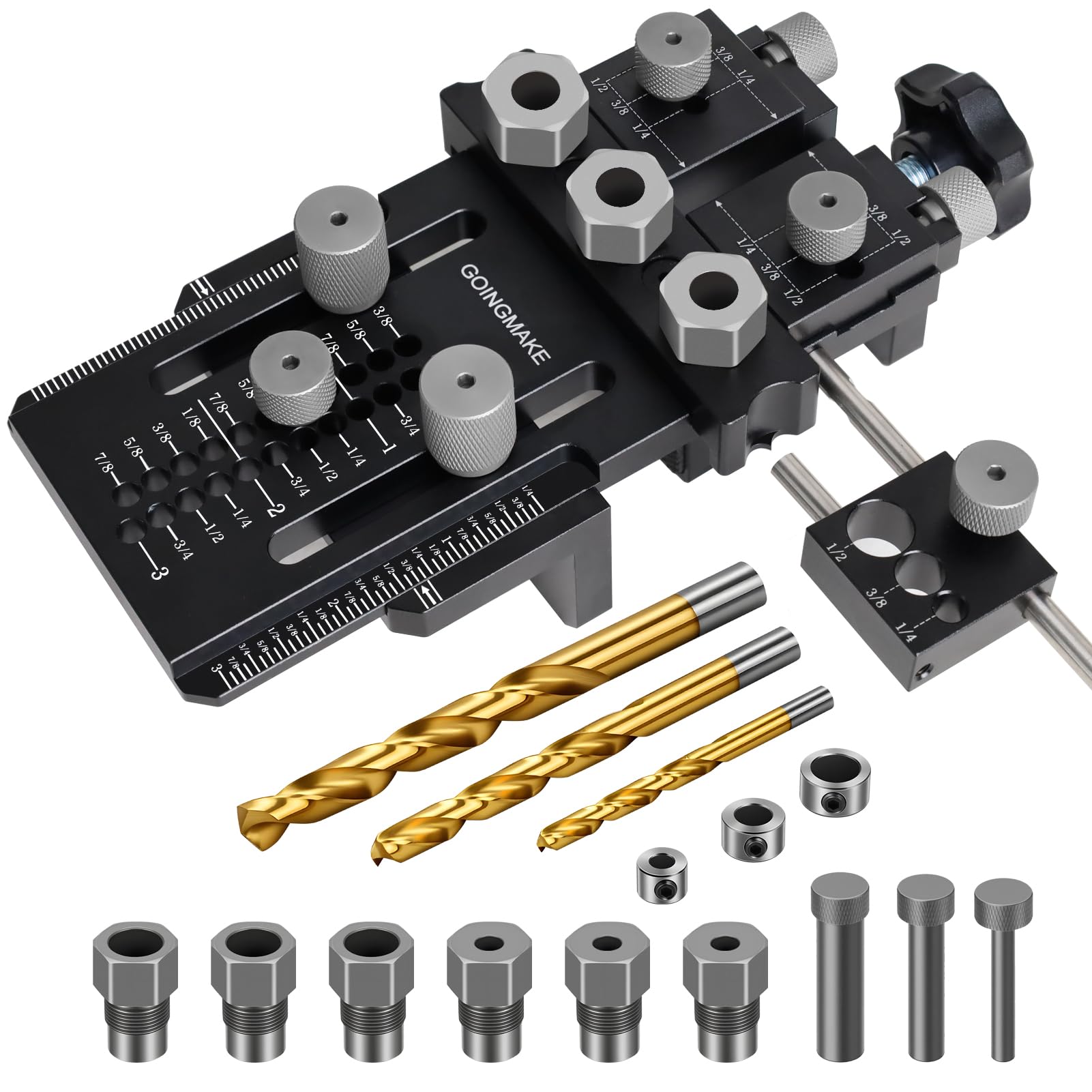
GOINGMAKE Dowel Jig Kit

86 /100
Craft Score Excellent

Key details

Body Material
All-metal
Board Thickness
Any (adjustable stop)
Clamping Mechanism
Quick clamp system
Included Accessories
3 bits, 9 bushings, stops
View on Amazon

Unlike the top pick’s bare-tool design, the GOINGMAKE comes ready to drill: three bits, depth stops, and nine hardened bushings cover 1/4, 3/8, and 1/2-inch dowels right out of the box. All-metal construction with hardened bushings shrugs off drill pressure that would flex plastic jigs. It’s a positional jig — not self-centering — so you set centers manually with the adjustable stop; once locked, positive stops deliver production-line consistency. This tradeoff suits cabinet and furniture makers who batch identical dowel patterns and prefer a complete kit over instant grab-and-drill convenience.

💡 Handle the alignment rod gently and verify square with a reliable straight edge — the extra care unlocks repeatable production results.

Pros

  • All-metal construction with hardened steel bushings
  • Handles butt, miter, edge, T, and multi-row joints without extra jigs.
  • Complete kit with bits and stops at a price that undercuts bare-bone alternatives.

Cons

  • Alignment rod may bend if handled roughly; squaring the jig demands patience.
Our verdict

If you prioritize a full, repeatable doweling system over zero-setup centering, the GOINGMAKE offers outstanding value for batch furniture and cabinet work.

Check Latest Price
5

Best for Large Panels

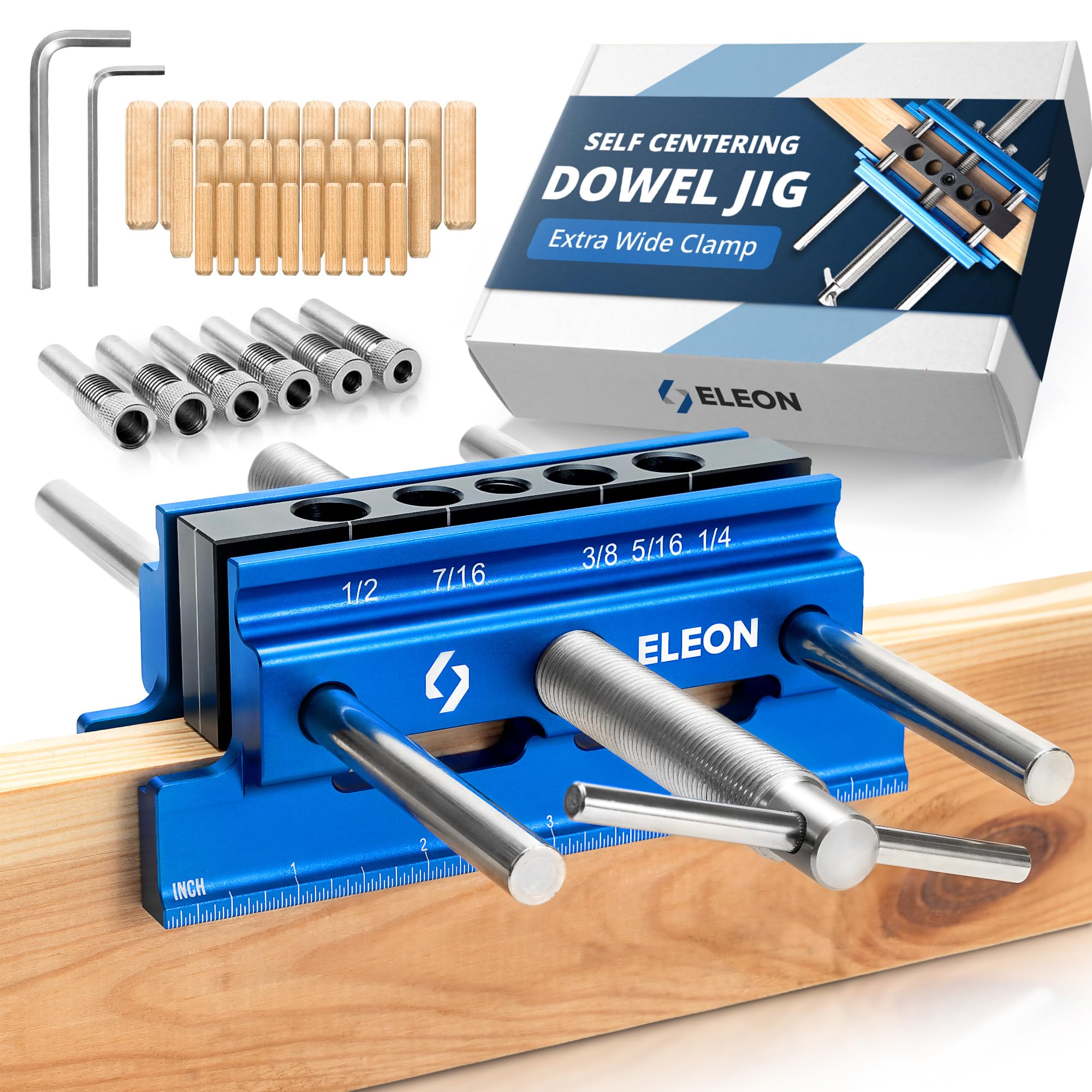
ELEON Dowel Jig

89 /100
Craft Score Excellent

Key details

Body Material
Aluminum alloy
Board Thickness
Clamping Mechanism
Wide clamp (up to 6.7″)
Included Accessories
6 bushings, 30 dowels
View on Amazon

The Eleon's generous 6.7-inch jaw capacity and solid aluminum build make it a standout for joining large boards and panels. Unlike heavy-duty self-clamping jigs that require test runs to nail side-to-side alignment, the elongated jaws and straightforward screw clamp provide quick, stable centering across substantial stock. The main tradeoff is that factory laser-etched alignment marks can be off-center, so this jig suits hobbyists and furniture makers who are willing to confirm and possibly recalibrate the scales. For those working with stock under 1/2 inch, the clamp's grip may not prevent rotation — keep this to medium and thick material where it excels.

💡 After unboxing, test the alignment marks on scrap — a quick recalibration ensures dead-center holes.

Pros

  • Wide 6.7-inch clamping capacity handles large panels with ease.
  • All-metal construction with no plastic flex feels substantial and holds tight.
  • Clear laser-etched scales and simple setup make it easy to use.

Cons

  • Factory alignment marks may be off-center, requiring verification or recalibration.
  • On thin stock under 1/2 inch, the clamping screw may not grip firmly enough to prevent rotation.
Our verdict

For furniture makers joining large panels, the Eleon offers huge clamping capacity at a mid-range price, provided you're comfortable double-checking the laser-etched scales.

Check Latest Price
6

Best Value Aluminum Jig

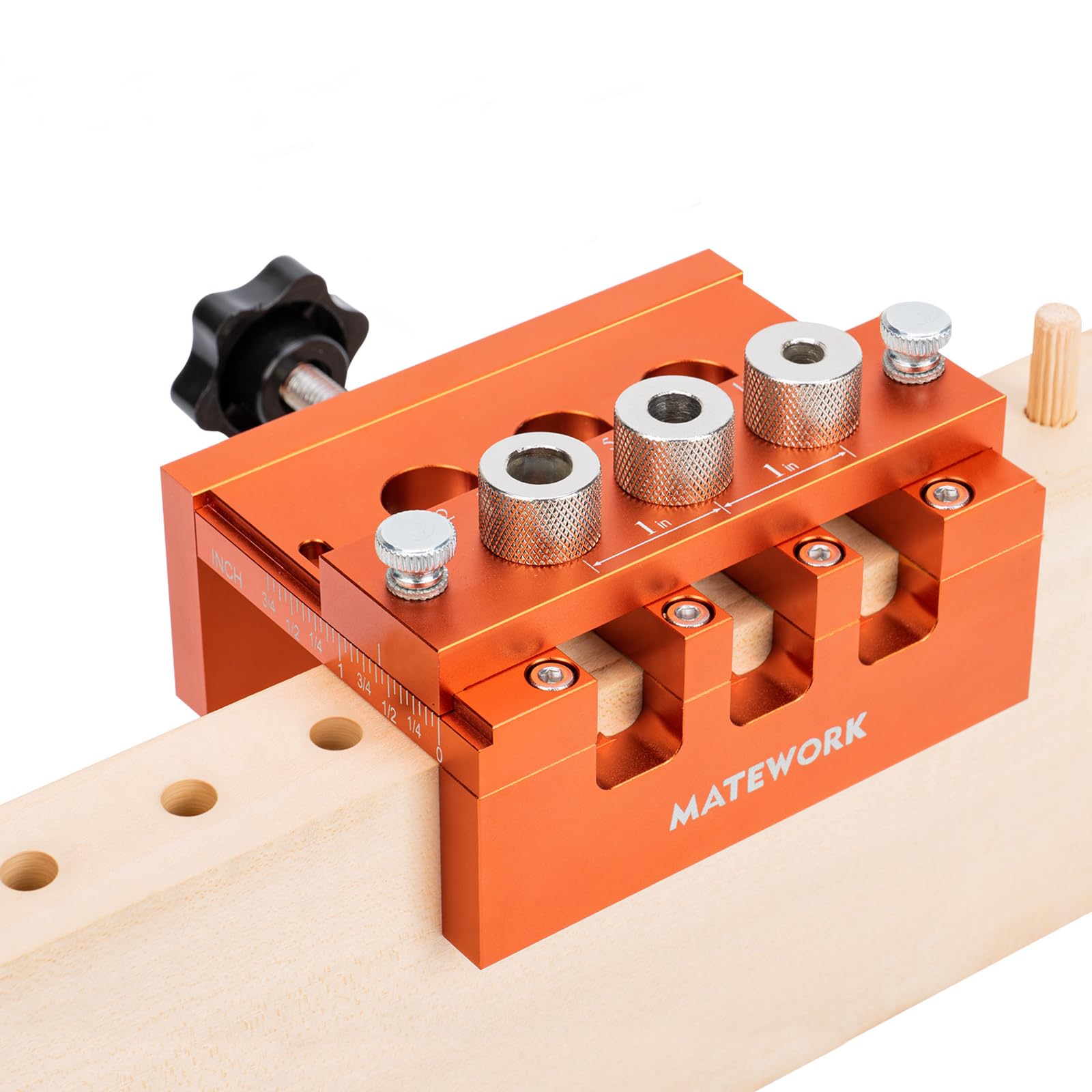
MATEWORK Dowel Jig

83 /100
Craft Score Excellent

Key details

Body Material
Aluminum
Board Thickness
3/8″ to 1-3/4″
Clamping Mechanism
Adjustable clamp
Included Accessories
3 bits, stop rings, hex wrenches
View on Amazon

Its standout feature is the imperial side scale — clearly etched and legible, it speeds centering without guesswork. The aluminum body and clamp hold steady during drilling, preventing wander that can ruin a glue-up. Compared to bulkier wide-capacity jigs, this one trades maximum jaw opening for a slimmer, more maneuverable design that still handles boards up to 1-3/4 inches thick.

DIYers and hobby carpenters building shelves, face frames, or occasional panel glue-ups will appreciate the immediate usability — the kit includes three drill bits, stop rings, and hex wrenches. The clamping knob can feel stiff, making rapid repositioning less enjoyable, so production-line users should look elsewhere. The included bits get you started, but upgrading them will pay off for projects demanding tight tolerances.

💡 If the knob feels too stiff, a dab of lubricant on the threads or an aftermarket handle can make repositioning easier during batch work.

Pros

  • Intuitive design with easy-to-read side scale for centering
  • Great value
  • Clamp holds firmly and prevents wandering during drilling

Cons

  • Clamping knob can be stiff and awkward, especially for users with smaller hands or repetitive adjustments
  • Included drill bits can dull quickly, leaving you reaching for an upgrade
Our verdict

For DIY joinery on mixed-thickness stock, this metal jig delivers consistent centering without the premium price tag — just plan on upgrading the bits for longer-term projects.

Check Latest Price
7

Metric Knock-Down

aboutool Dowel Jig Kit

85 /100
Craft Score Excellent

Key details

Body Material
6061 aluminum
Board Thickness
0–1.33″
Clamping Mechanism
Handheld
Included Accessories
3 metric bits, organizer bag
View on Amazon

The aboutool delivers an aluminum body that feels more substantial than plastic jigs at this price, and its 8, 10, and 15 mm bits cover the most common metric dowel sizes for flat-pack furniture and cam-lock joinery. The included organizer bag makes it easy to grab for site work. Bore sizing can drift slightly from bushing play, which is fine for knock-down assembly but limits this jig for tight furniture joinery where hole diameter matters.

Pros

  • Aluminum body feels quality, a step above plastic jigs at this mid-range price.
  • Includes 8/10/15 mm bits and a carry bag, ready for European-style flat-pack assembly.

Cons

  • Drill bushings may have play, causing slightly oversized holes
Our verdict

The aboutool kit works well for assembling IKEA-style cam-lock furniture and small panel projects where metric dowels are standard. If you need absolute centering precision for shop joinery, consider a jig with zero-play steel bushings.

Check Latest Price
8

Light-Duty Learning

Richelieu Doweling Kit

86 /100
Craft Score Excellent

Key details

Body Material
Plastic
Board Thickness
1/2″ to 1-1/4″
Clamping Mechanism
Requires separate clamps (2 incl.)
Included Accessories
2 clamps, 3 depth stops, 6 dowels
View on Amazon

With two clamps and depth stops included, this kit gets first-time dowelers started without extra purchases. Plastic parts can crack if dropped, so it's best treated as a learning tool for occasional jobs. Simple butt joints and quick shelving are its domain — skip it for fine furniture.

Pros

  • Long-standing design embraced by casual woodworkers for its simplicity and approachable results.
  • Included clamps and depth stops speed up setup for semi-repeatable doweling without added purchases.

Cons

  • Plate alignment can be imprecise, requiring sanding or planing to bring joints flush after glue-up.
Our verdict

A sensible choice for first-time dowelers making shelving or other non-show joints, where a little extra sanding won't spoil the result.

Check Latest Price
9

Ultra-Portable Spare

Yakamoz Doweling Jig

87 /100
Craft Score Excellent

Key details

Body Material
Anodized aluminum
Board Thickness
Up to 45 mm
Clamping Mechanism
Handheld
Included Accessories
Jig only
View on Amazon

The Yakamoz jig is a tiny, all-aluminum guide for 6/8/10 mm dowels — light enough to live in an apron pocket. It costs little and works for quick, non-critical holes. Centering, however, can shift by up to 1/8 inch, so it’s a lightweight backup, not a go-to for joints that need flush alignment.

Pros

  • Extremely compact and portable, ideal for quick one-off drillings.
  • Low cost makes it a consumable; no worry if it gets lost or damaged.

Cons

  • Bushings can be rough or poorly machined, causing drill bit wobble and less accurate holes.
Our verdict

This jig serves as a cheap backup for non-critical holes or metric-only shops, but when accuracy matters, reach for a more precise centering tool.

Check Latest Price
10

3/4″ Plywood Only

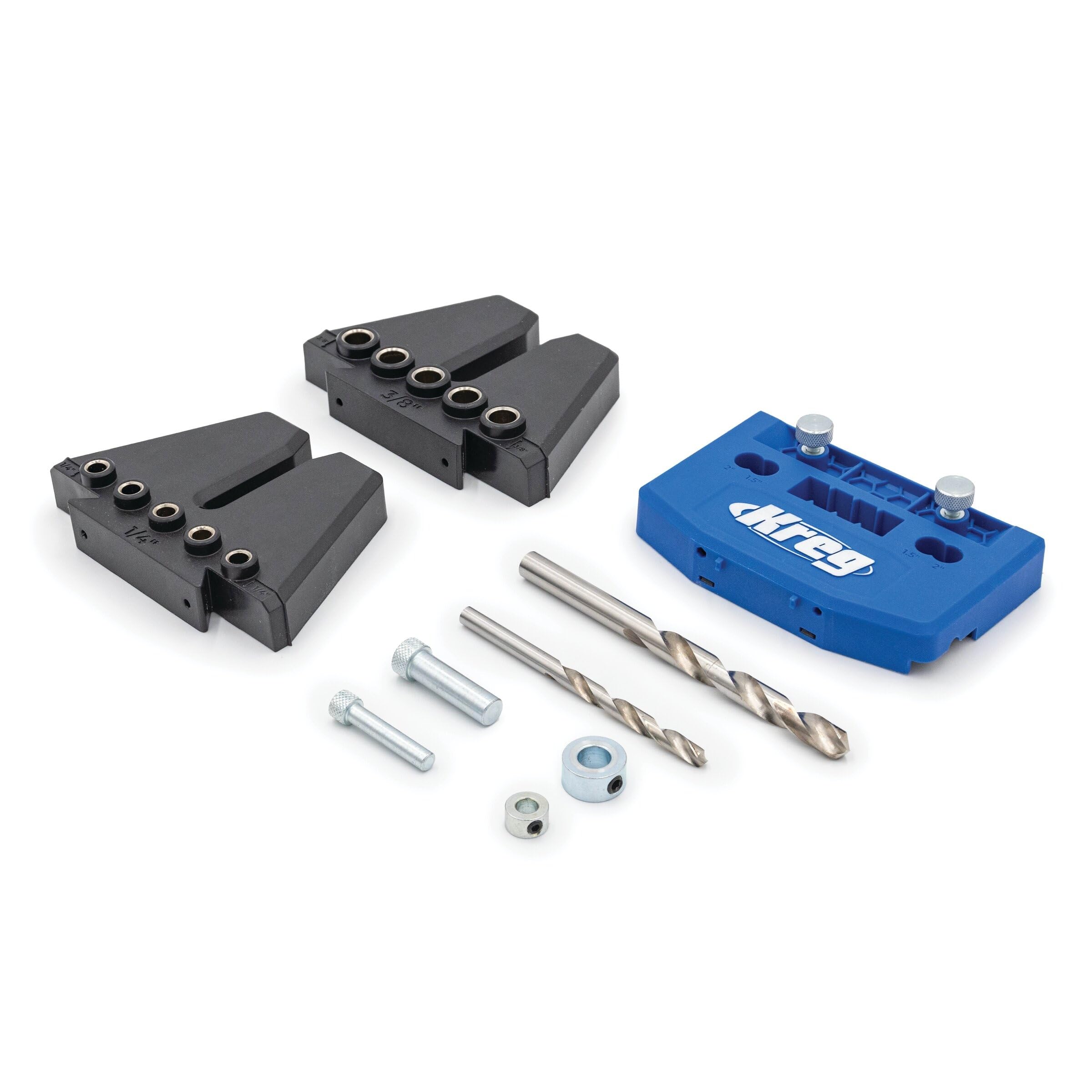
Kreg Dowel Jig Kit

85 /100
Craft Score Excellent

Key details

Body Material
Plastic body, metal guides
Board Thickness
3/4″ only
Clamping Mechanism
Clamp-on edge guide
Included Accessories
Jig, drill guides, alignment pin
View on Amazon

The Kreg Dowel Jig Kit delivers quick, no-measure edge holes on standard 3/4-inch material, with solid build and beginner-friendly indexing marks. However, it's not a self-centering jig — it's limited to 3/4-inch stock, so if you need centering across varying thicknesses, this isn't the tool.

Pros

  • Quick no-measure setup for repetitive edge doweling.
  • Solid build feel with clear indexing marks

Cons

  • Drill guides can have slight play, leading to off-center holes even on 3/4-inch stock.
Our verdict

A timesaver if your work revolves exclusively around 3/4-inch plywood; not a centering jig for varied material thicknesses.

Check Latest Price

How to Choose

Body Material

Plastic jigs are light and inexpensive, but plastic flexes under a drill’s lateral pressure and jars out of alignment. Hardened steel or aluminum bodies resist torque and maintain bushing alignment hole after hole, directly improving centerline repeatability. Even a seemingly rigid plastic body can warp when you bear down, resulting in holes that angle outward or drift off-center.

A metal jig’s extra mass also helps damp vibration, reducing walk. If you plan to dowel more than a couple of projects a year, the jump to aluminum or steel is the single largest durability upgrade you can make.

Self-Centering Accuracy

Self-centering mechanisms use spring-loaded pins or elongated jaws to find the board’s midpoint — but manufacturing tolerances in budget jigs often shift that midpoint by 1/32 inch or more. That tiny error produces a step at the joint that must be sanded or planed flush. The most precise jigs use hardened steel centering blocks machined to exacting tolerances, leaving zero measurable drift.

If your project demands invisible joints on fine furniture, look for centering systems with a track record of zero off-center complaints. For shop carts or utility shelving, a jig that centers within a hair may be perfectly acceptable.

Clamping Mechanism

A jig held only by hand pressure can creep the instant the drill bit bites, shifting the hole’s position by a fraction of an inch. Built-in clamps or a geometry that accepts your own clamps lock the jig to the workpiece, preventing drift. Self-clamping designs are especially valuable for edge joints where you can’t easily brace the jig against a bench.

Handheld jigs work for careful, low-volume work when you use a firm, two-handed grip and moderately paced drilling. But if you plan to dowel dozens of joints in one session, the lost concentration from constantly fighting the jig makes a clamping model worth the upgrade.

Included Accessories

A jig that arrives with matching brad-point bits, depth stops, and dowel centers eliminates the need to chase down precise bit sizes — and reduces the chance of a slightly oversized bit wallowing out the bushing. Kits that bundle glue and a storage case reduce up-front friction, especially for beginners.

However, the bits in budget kits are often consumable-grade. If you already own high-quality brad-point bits, a bare-jig purchase puts the money where it counts: into the centering mechanism and body rigidity.

Board Thickness Compatibility

Jigs that can only center on a fixed dimension — most commonly 3/4 inch — become useless the moment you switch to 1/2-inch drawer sides or 1-inch table aprons. Adjustable-centering jigs, or those with a wide clamping range and dual-sided markings, let you dial in the exact midpoint for varied stock without guesswork.

When a jig’s fixed offset forces you to measure and shim on every setup, you lose the speed that doweling promises. For a production workflow where you swap between multiple board dimensions, an adjustable solution pays for itself in reduced scrap.

Frequently Asked Questions