6 Best 12 Inch Miter Saw of 2026: Avoid Overbuying Sliding Capacity

Find the 12-inch miter saw that matches your actual cutting needs — whether for framing, trim, or DIY projects. Avoid paying for features you won't use.

Many woodworkers and DIYers assume a sliding 12-inch miter saw is always the better choice. But the extra weight, cost, and footprint only pay off if you regularly cut wide boards like 2x12s or crown molding nested flat. For trim work and baseboards, a non-sliding saw often delivers tighter accuracy and easier portability.

The cutline guide — whether a laser, LED shadow, or simple scribe line — is one of the most underrated features. Lasers drift and wash out in sunlight; shadow systems like DEWALT's XPS stay consistent and require no adjustment. Choosing the wrong cutline can add minutes per cut or cause waste.

This guide focuses on matching the saw to your specific cuts — not on abstract specs. We highlight the trade-offs between sliding and non-sliding, bevel type, and cutline reliability so you can buy with confidence.

1

Best Overall

DEWALT DWS779

96 /100
Craft Score Outstanding

Key details

Weight
67.7 lbs
Bevel Type
Double
Slide Type
Sliding
Motor Power
15A, 3800 RPM
View on Amazon

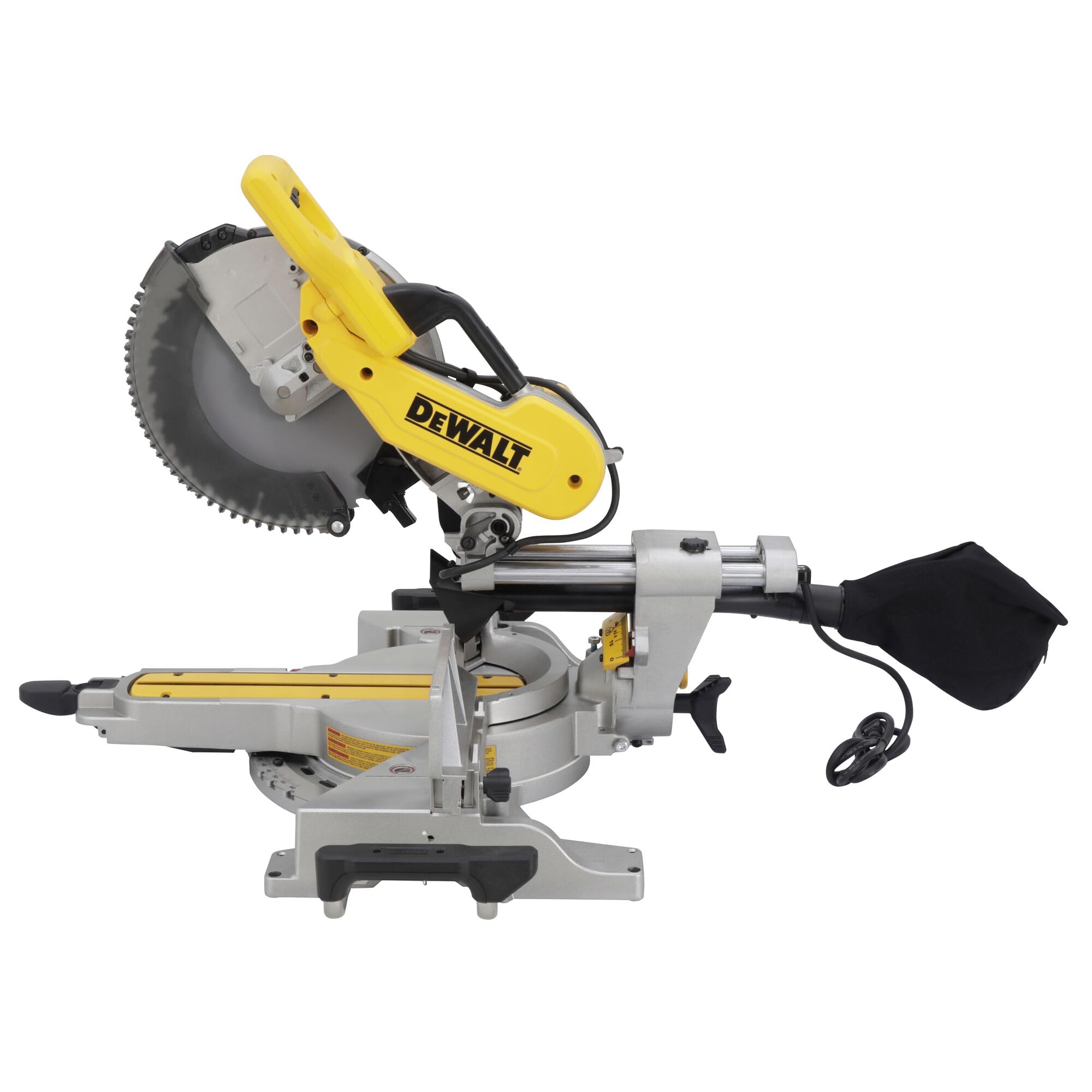
The DWS779 crosscuts 2x14 at 90 degrees and 2x10 at 45 degrees — enough capacity for most framing and large trim work. Its 15-amp motor runs smoothly through dense hardwoods, and the double-bevel design lets you flip angles without moving the workpiece.

Cut quality stays consistent across dimensional lumber and thick stock, with little blade deflection during heavy passes. The sliding mechanism tracks well, though the saw's 67.7-lb weight means it's best set up in one spot under a rolling stand.

This saw is aimed at professional framers and serious DIYers who need maximum cutting capacity and are comfortable with a heavier build. It's less suitable for trim carpenters who require a cutline guide or frequently move the saw between sites.

💡 A sturdy rolling stand makes moving the saw between workstations manageable without lifting.

Pros

  • Crosscuts up to 2x14 at 90 degrees and 2x10 at 45 degrees for large lumber
  • Double-bevel adjustment without flipping the workpiece saves time on compound cuts
  • Consistent cutting accuracy, particularly for crown molding and angled joinery

Cons

  • At 67.7 lbs, moving it without a stand is difficult
  • No cutline guide means precision trimming requires an aftermarket shadow system or laser
Our verdict

If you need a sliding double-bevel saw for heavy framing and don't mind the weight or adding a cutline accessory, this is the most capable option for the price.

Check Latest Price
2

Best for Trim & Crown Molding

DEWALT DWS716XPS

94 /100
Craft Score Outstanding

Key details

Weight
49 lbs
Bevel Type
Double
Slide Type
Non-Sliding
Motor Power
15A, 4500 RPM
View on Amazon

The DEWALT DWS716XPS stands out among 12-inch miter saws for its XPS shadow cutline system, which projects a precise blade-width shadow instead of a laser that can drift. This, combined with a double bevel that tilts left and right without requiring the saw head to flip, makes it a go-to for crown molding and trim work where accuracy and speed matter. The saw is 49 pounds, notably lighter than sliding models, and the non-sliding design eliminates the rail mechanism that can introduce play over time.

This saw fits trim carpenters and crown molding installers who prioritize cutline visibility and consistent miters over wide crosscut capacity. It also suits DIYers who want a lightweight, accurate saw for medium-duty projects. However, the non-sliding design limits crosscuts to about 8 inches in one pass – not suitable for cutting 2x12s or other large dimensional lumber. If your work involves framing or wide boards, consider a sliding model like the DEWALT DWS779.

Pros

  • XPS shadow cutline eliminates laser drift and provides instant cut visibility.
  • Double bevel and consistent stops allow fast, repeatable cuts for crown molding.
  • At 49 pounds, it's portable enough for job site movement without sacrificing stability.

Cons

  • Blade wobble or motor issues can appear after moderate use, particularly in high-volume settings.
Our verdict

The DWS716XPS is the right choice if your priority is cutline accuracy and you don't need sliding capacity. For framing or wide boards, look to a sliding saw.

Check Latest Price
3

Premium Smooth Operator

Makita LS1219L

86 /100
Craft Score Excellent

Key details

Weight
81.6 lbs
Bevel Type
Double
Slide Type
Sliding
Motor Power
15A, 3200 RPM
View on Amazon

The Makita LS1219L delivers the smoothest sliding action among 12-inch miter saws, thanks to its dual-rail system, and offers a generous 15-inch crosscut capacity at 90 degrees. That combination is hard to find elsewhere.

This saw is built for professional carpenters who prioritize slide smoothness and wide cutting range for crown molding or large stock. However, the rails may not be perfectly parallel out of the box, leading to curved cuts until calibration. Owners willing to fine-tune will find a capable tool, but those seeking instant accuracy should consider alternative models with more consistent setup. The dust collection also may not capture all debris even with a vacuum, making a shop vacuum or dust separator helpful in enclosed spaces.

Pros

  • Smooth dual-rail slide mechanism for effortless cuts.
  • 15-inch crosscut capacity handles wide stock and large crown molding.
  • Dual-bevel design with positive stops for quick miter adjustments.

Cons

  • In a finished room, dust collection may leave fine particles behind even with a shop vacuum.
  • On job sites requiring frequent repositioning, the 81.6 lb weight may require a wheeled stand or assistance.
Our verdict

The LS1219L stands out for its buttery-smooth slide and 15-inch crosscut capability — a clear choice for crown molding and large stock.

Check Latest Price
4

Best Budget Sliding Saw

DOVAMAN DMS03G

85 /100
Craft Score Excellent

Key details

Weight
53.9 lbs
Bevel Type
Double
Slide Type
Sliding
Motor Power
15A, 3800 RPM
View on Amazon

This DOVAMAN 12-inch sliding compound miter saw delivers dual-bevel capability and a laser cutline at a price that undercuts most competitors. The 15-amp motor handles crosscuts up to 4.2x13 inches and makes smooth cuts in common dimensional lumber and plywood, which is enough for shelving, basic framing, and DIY furniture.

Best suited for budget-conscious DIYers who need sliding and dual-bevel for occasional projects like simple framing or shelving. The tradeoff is that build quality can vary — plastic components such as the handle and fence may break, and the laser alignment is not adjustable on some units. For light, infrequent use these limitations are manageable, but anyone planning heavy or daily cutting should consider a more robust saw.

💡 Check the laser alignment and plastic parts on arrival, as unit-to-unit consistency can vary.

Pros

  • Sliding dual-bevel design with laser guide at a budget-friendly price
  • Competent cutting performance for light to moderate DIY tasks
  • Laser guide aids alignment for basic miter cuts

Cons

  • Laser alignment may not be adjustable on some units, affecting precision on repeated cuts
  • Plastic handle and fence components can break under stress, limiting durability for frequent use
Our verdict

A good entry-level choice for homeowners with occasional cutting needs who are willing to accept variable build quality.

Check Latest Price
5

Best Budget Compound Saw

SKIL 3821-01

87 /100
Craft Score Excellent

Key details

Weight
42.5 lbs
Bevel Type
Single
Slide Type
Non-Sliding
Motor Power
15A, 4500 RPM
View on Amazon

The SKIL 3821-01 is a no-frills compound miter saw built around a laser guide and a fixed non-sliding base. It delivers consistent cutting performance for lighter tasks, with a build that holds up over years of weekend use. The 15-amp motor spins the 12-inch blade at 4,500 RPM — enough for common trim and crosscuts up to 8 inches wide. At its budget price point, it offers a laser guide that helps with cutline visibility, though alignment can be off on some units and may require a check before use.

This saw is suited for homeowners and DIYers who need a basic compound saw for occasional trim work, light framing, and crosscutting. The non-sliding design and single bevel mean it won't handle wide lumber or double-bevel cuts, but those are not requirements for most weekend projects. The laser guide is a helpful addition, though the adjustment may be needed out of the box — a minor step for the savings.

💡 If the laser is off, try adjusting the set screws — many units allow correction.

Pros

  • Durable for moderate use
  • Cost-effective compound saw with laser guide.

Cons

  • Laser guide may require manual alignment; not adjustable on every unit.
  • Non-sliding design limits crosscut to about 8 inches
Our verdict

A capable entry-level saw for basic cuts, but check the laser alignment before your first project.

Check Latest Price
6

Ultra-Light Sliding

MarvTool JS-1207C3

86 /100
Craft Score Excellent

Key details

Weight
39.6 lbs
Bevel Type
Double
Slide Type
Sliding
Motor Power
15A, 3800 RPM
View on Amazon

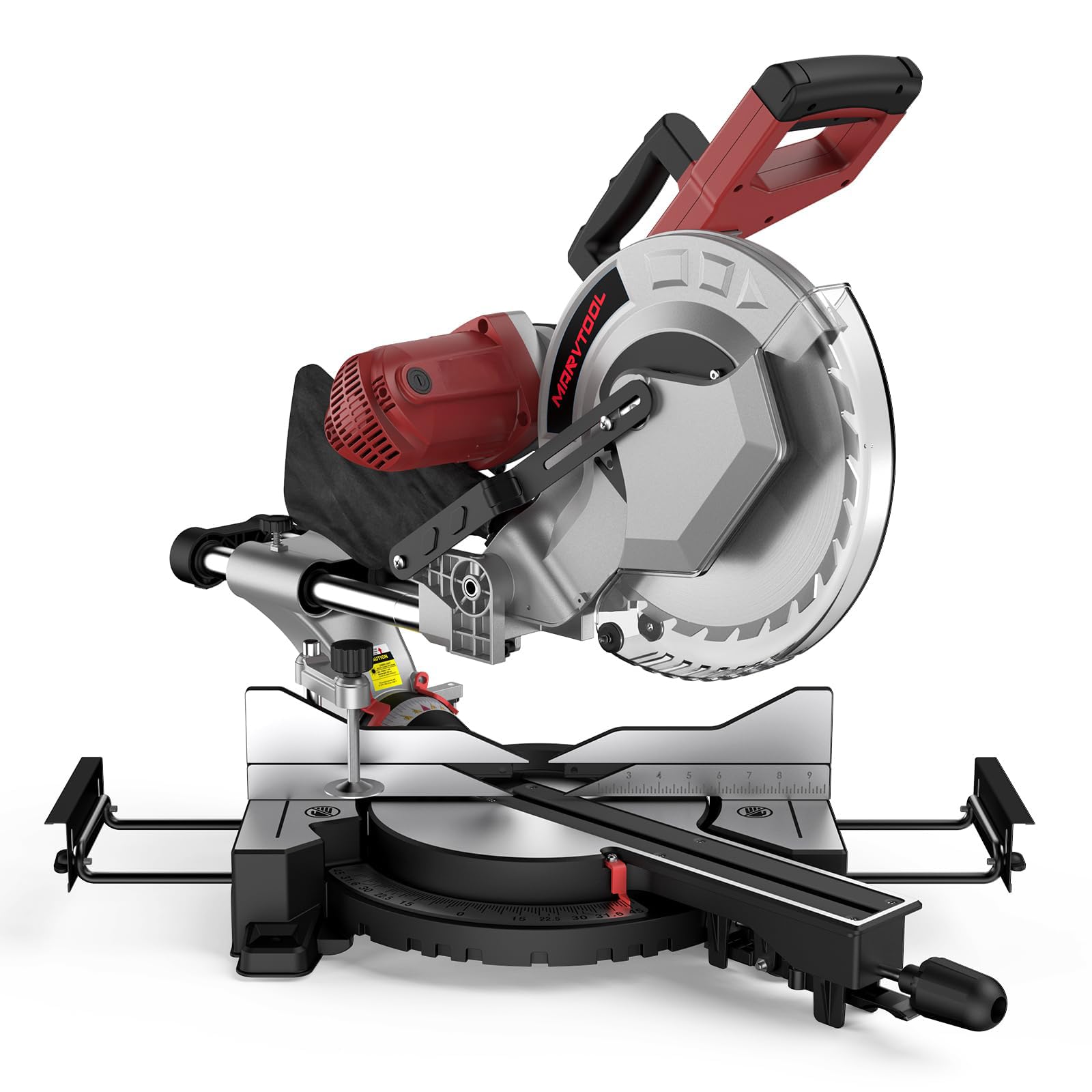
The MarvTool JS-1207C3 is the lightest sliding saw on the market at under 40 lbs, and its extension tables add real value for the price. However, build quality can be inconsistent, which makes long-term durability uncertain for anything beyond light DIY use. For the same budget, an alternative with more documented reliability is available, but no other saw matches this weight for portability. This saw is best suited for budget-conscious DIYers who prioritize portability over longevity.

Pros

  • Weighs under 40 lbs for easy portability and storage.
  • Includes extension tables that increase cutting capacity for the price.

Cons

  • Plastic lever and handle mounts can crack under pressure, affecting durability.
  • Laser guide alignment may shift when adjusted, reducing cutline accuracy.
Our verdict

Works for occasional DIY projects if you accept potential plastic part wear and can tolerate the laser's quirkiness.

Check Latest Price

How to Choose

Slide Type: Sliding vs Non-Sliding

Sliding saws use rails to pull the blade forward, letting you cut wide boards like 2x12s and 4x4s in a single pass. The trade-off is added weight (often 50–70 lbs), a larger footprint, and more mechanical parts that can lose alignment over time.

Non-sliding saws are lighter, more compact, and typically hold alignment better because the motor moves only vertically. For trimming baseboards, cutting 2x4s, or simple crosscuts, a non-sliding saw is often faster and more accurate — and costs less.

Bevel Type: Single vs Double

Single-bevel saws tilt only to the left for angled cuts. To cut an opposite bevel, you must flip the workpiece. Double-bevel saws tilt both left and right, saving time on crown molding and compound miters where both angles are needed.

For most DIYers, a single bevel is sufficient — you can flip the board. But if you regularly install crown molding or do complex trim work, the convenience of double bevel pays for itself quickly.

Cutline System: XPS, Laser, or None

Shadow cutline systems like DEWALT's XPS use a bright LED to cast a sharp blade shadow onto the workpiece. They don't drift, require no calibration, and remain visible even in direct sunlight. Lasers are common on budget saws but are prone to misalignment, need frequent adjustment, and wash out outdoors.

A saw with no cutline guide forces you to rely on a scribe line and manual alignment. This is workable for rough cuts but slows down precision work. If you value speed and accuracy, invest in a shadow system.

Motor Power: 15A Standard

All 12-inch miter saws in this guide use a 15-amp motor, which provides ample power for cutting hardwood and treated lumber. RPM differences (3200–4500) matter less than blade quality and sharpness. A 3800 RPM saw with a good blade outperforms a 4500 RPM saw with a dull blade.

The key is consistent power delivery. Brushless motors (rare in this category) offer slightly longer life and less vibration, but the standard brushed 15A motor handles daily job-site use without issues.

Weight and Portability

Heavier saws (over 65 lbs) feel more stable during cuts but are a chore to move between job sites without a rolling stand. Lighter models (under 45 lbs) are easier to carry but may vibrate more on thin workpieces.

If you work from a fixed workshop, weight matters little. For frequent moves, a saw under 50 lbs or one with integrated carry handles saves your back. Many heavy saws accept a universal stand with wheels for easier rolling.

Frequently Asked Questions